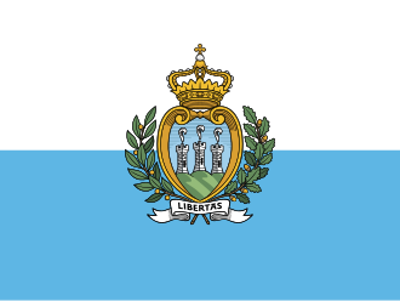
San Marino, officially the Republic of San Marino (RSM), is a landlocked country in Southern Europe, completely surrounded by Italy. Located on the northeastern slopes of the Apennine Mountains, it is the larger of two microstates within the Italian Peninsula, the other being Vatican City. San Marino is the fifth-smallest country in the world, with a land area of just over 61 square kilometres (24 sq mi) and a population of 34,042 as of 2025 which in 2026 dropped to 33,559. Its capital, the City of San Marino, sits atop Monte Titano, while its largest settlement is Dogana, in the municipality of Serravalle. San Marino claims to have been founded in AD 301 and to be the oldest extant sovereign state, and the oldest constitutional republic. It is named after Saint Marinus, a stonemason from the Roman island of Rab (in present-day Croatia), who fled persecution under Emperor Diocletian to have established a monastic community on Monte Titano, where he built a small chapel. The country has a rare constitutional structure: the Grand and General Council, a democratically elected legislature, selects two heads of state, the Captains Regent, every six months. They are chosen from opposing political parties, and serve concurrently with equal powers and preside over several institutions of state, including the Grand and General Council. Only the Federal Council of Switzerland follows this same structure, except with some modifications due to its immensely larger size.
Feast of San Marino and the Republic, celebrates the foundation of the Republic of San Marino in 301.
On September 3, in the year 0, Feast of San Marino and the Republic, celebrates the foundation of the Republic of San Marino in 301. This event is recorded as a Holidays event in the history of September 3, one of 429 recorded events on this date across all of history.
Key Facts
- This event took place on September 3, 0 (AD era).
- It is categorised as a Holidays event in recorded history.
- Referenced in 1 Wikipedia article.
- The event is associated with a specific geographical location (see map below).
- Wikipedia source last updated on 29 August 2026.
On This Date in History 429
This article draws on content from Wikipedia, available under CC BY-SA 4.0.
More on September 3
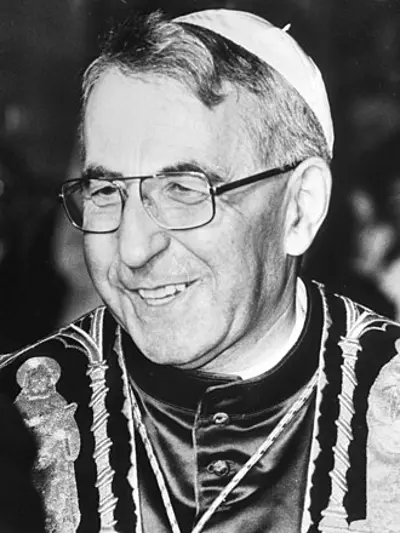
Christian feast day: Blessed Bartholomew Gutierrez
Beatification is an act by which the Catholic Church formally recognizes that a deceased member of the faithful is believed to have entered Heaven and is capable of interceding on…
Christian feast day: Blessed Bartholomew Gutierrez
Christian feast day: Blessed Brigida Morello Zancano
Beatification is an act by which the Catholic Church formally recognizes that a deceased member of the faithful is believed to have entered Heaven and is capable of interceding on…
Christian feast day: Blessed Brigida Morello Zancano
Christian feast day: Phoebe
Phoebe was a first-century Christian deacon mentioned by the Apostle Paul in his Epistle to the Romans, verses 16:1–2. A notable woman in the church of Cenchreae, she was trusted …
Christian feast day: Phoebe
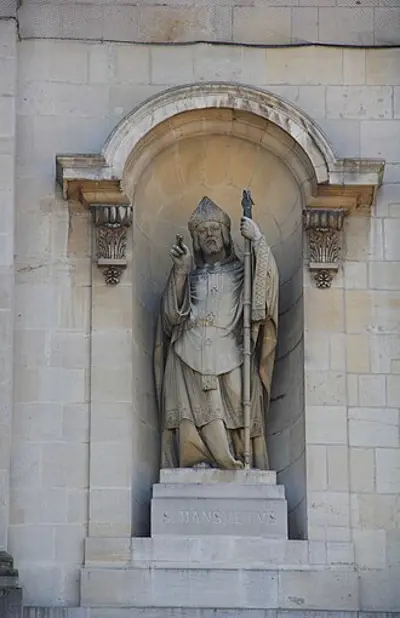
Christian feast day: Mansuetus of Toul
Saint Mansuetus was the first Bishop of Toul.
Christian feast day: Mansuetus of Toul
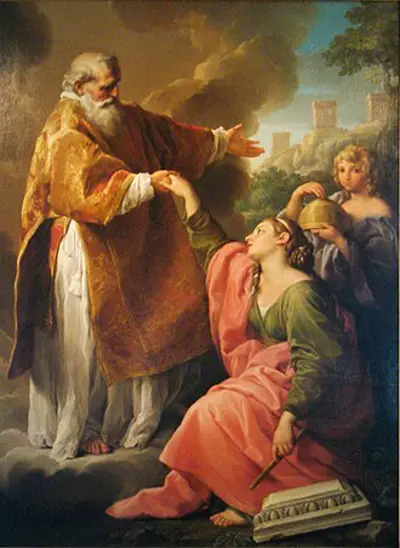
Christian feast day: Marinus
Marinus is a Christian saint, who according to hagiographical accounts recorded centuries after his lifetime was the founder of a chapel and monastery in 301 from whose initial co…
Christian feast day: Marinus
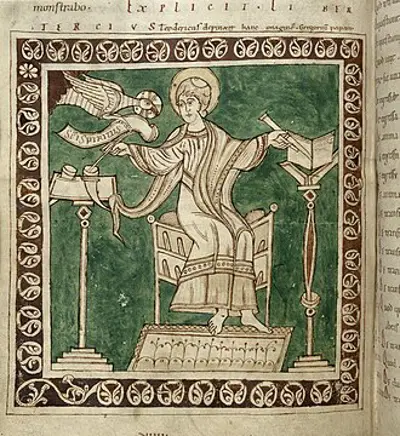
Christian feast day: Pope Gregory I
Pope Gregory I, commonly known as Saint Gregory the Great, was the 64th Bishop of Rome from 3 September 590 until his death on 12 March 604.
Christian feast day: Pope Gregory I
Comments 0
Sign in to join the discussion.