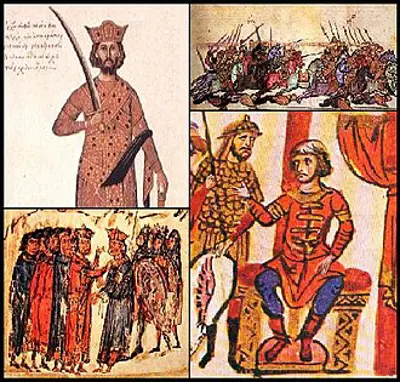
The Byzantine–Bulgarian wars were a series of conflicts fought between the Byzantine Empire and the Bulgarian Empire which began after the Bulgars conquered parts of the Balkan peninsula after 680 AD. The Byzantine and First Bulgarian Empire continued to clash over the next century with varying success, until the Bulgarians, led by Krum, inflicted a series of crushing defeats on the Byzantines. After Krum died in 814, his son Omurtag negotiated a thirty-year peace treaty. Simeon I had multiple successful campaigns against the Byzantines during his rule from 893 to 927. His son Peter I negotiated another long-lasting peace treaty. His rule was followed by a period of decline of the Bulgarian state.
Byzantine–Bulgarian wars: Byzantine forces defeated troops of the Bulgarian Empire at the Battle of Kleidion in the mountains of Belasica near present-day Klyuch.
On July 29, in the year 1014, Byzantine–Bulgarian wars: Byzantine forces defeated troops of the Bulgarian Empire at the Battle of Kleidion in the mountains of Belasica near present-day Klyuch. This event is recorded as a Selected Events event in the history of July 29, one of 426 recorded events on this date across all of history.
Key Facts
- This event took place on July 29, 1014 (AD era).
- It is categorised as a Selected Events event in recorded history.
- Referenced in 6 Wikipedia articles.
- Wikipedia source last updated on 6 June 2026.
On This Date in History 426
This article draws on content from Wikipedia, available under CC BY-SA 4.0.
More on July 29
1900
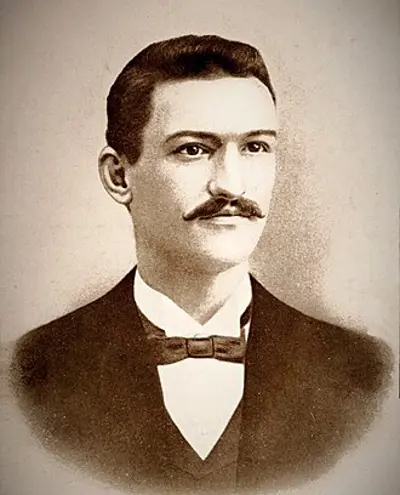
Italian-American anarchist Gaetano Bresci (pictured) assassinated King Umberto I of Italy in Monza.
Gaetano Bresci was an Italian anarchist who assassinated King Umberto I of Italy. His experience working as a young weaver led him to the conclusion that he had faced exploitation…
Italian-American anarchist Gaetano Bresci (pictured) assassinated King Umberto I of Italy in Monza.
1981
45 years ago
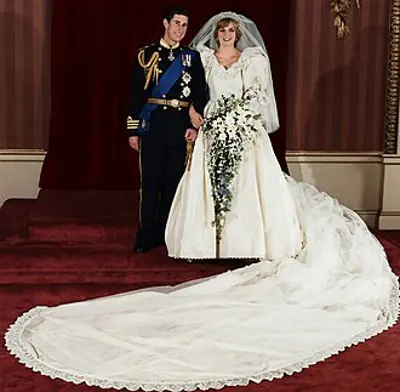
An estimated worldwide television audience of 750 million watched the wedding of Prince Charles and Lady Diana Spencer…
The wedding of Prince Charles and Lady Diana Spencer took place on Wednesday, 29 July 1981, at St Paul's Cathedral in London, England. The groom was the heir apparent to the Briti…
An estimated worldwide television audience of 750 million watched the wedding of Prince Charles and Lady Diana Spencer…
1954
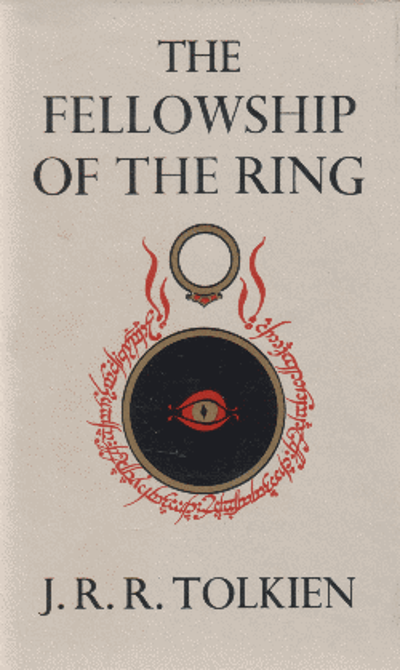
The Fellowship of the Ring, the first part of J. R. R. Tolkien's novel The Lord of the Rings, was published by Allen &…
The Fellowship of the Ring is the first of three volumes of the epic novel The Lord of the Rings by the English author J. R. R. Tolkien; it is followed by The Two Towers and The R…
The Fellowship of the Ring, the first part of J. R. R. Tolkien's novel The Lord of the Rings, was published by Allen &…

1950
Korean War: Over fears that North Korean soldiers were infiltrating refugee columns, U.S. forces concluded a four-day…
The Korean War was an armed conflict fought on the Korean Peninsula between North Korea and South Korea and their allies. North Korea was supported by China and the Soviet Union, …
Korean War: Over fears that North Korean soldiers were infiltrating refugee columns, U.S. forces concluded a four-day…
1938
The Essential Commodities Reserves Act, which allowed the British government to build up reserves of essential…
The Essential Commodities Reserves Act 1938 is an Act of the Parliament of the United Kingdom. It was passed in anticipation of the Second World War and allowed the Board of Trade…
The Essential Commodities Reserves Act, which allowed the British government to build up reserves of essential…

1921
105 years ago
Adolf Hitler became leader of the National Socialist German Workers' Party.
Adolf Hitler was an Austrian-born German politician who was dictator of Germany in the Nazi era from 1933 until his suicide in 1945. He rose to power as the leader of the Nazi Par…
Adolf Hitler became leader of the National Socialist German Workers' Party.
Comments 0
Sign in to join the discussion.