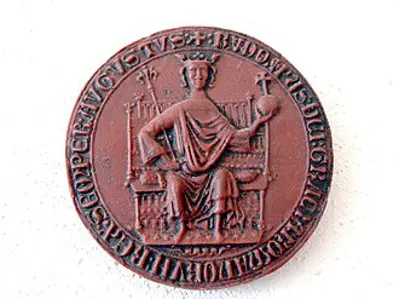
Rudolf of Habsburg (1 May 1218 – 15 July 1291) was a German nobleman and the first member of the House of Habsburg to become King of the Romans, reigning from 1273 until his death. Born into a relatively minor noble family, Rudolf succeeded his father as Count of Habsburg in 1240, gradually expanding his power through military campaigns, political alliances, and the construction of key fortresses such as Neuhabsburg Castle. His marriage to Gertrude of Hohenberg further strengthened his position among the Swabian nobility. During the turbulent period of the Great Interregnum, Rudolf distinguished himself both as a formidable military leader—participating in regional conflicts and even joining the Prussian Crusade in 1254—and as a restorer of order, often intervening against robber barons and feuding nobles. Despite facing excommunication due to disputes with the Church, Rudolf ultimately reconciled with ecclesiastical authorities and built a reputation for fairness and pragmatism. In 1273, he was elected King of the Romans, ending decades of imperial vacancy and division. As king, Rudolf reasserted imperial authority in Germany, notably defeating King Ottokar II of Bohemia and securing Habsburg control over Austria, Styria, and Carinthia. His reign laid the foundations for the rise of the Habsburg dynasty, which would become one of the most influential royal houses in European history. Rudolf died in 1291, leaving a legacy of restored stability and dynastic ambition within the Holy Roman Empire.
Rudolf I of Germany (born 1218)
On July 15, in the year 1291, Rudolf I of Germany (born 1218). This event is recorded as a Notable Deaths event in the history of July 15, one of 457 recorded events on this date across all of history.
1 notable person is associated with this event, including Rudolf I of Germany. Learn more below.
Key Facts
- This event took place on July 15, 1291 (AD era).
- It is categorised as a Notable Deaths event in recorded history.
- Referenced in 1 Wikipedia article.
- 1 notable person is recorded as involved in or associated with this event.
- Wikipedia source last updated on 11 June 2026.
On This Date in History 457
This article draws on content from Wikipedia, available under CC BY-SA 4.0.
People Involved
More on July 15

Peter R. de Vries, Dutch investigative journalist and crime reporter (born 1956)
Peter Rudolf de Vries was a Dutch investigative journalist and crime reporter. His television program Peter R. de Vries, misdaadverslaggever covered high-profile cases and set a D…
Peter R. de Vries, Dutch investigative journalist and crime reporter (born 1956)

Martin Landau, American film and television actor (born 1928)
Martin James Landau was an American actor. His career began in the late 1950s, with early film appearances including a supporting role in Alfred Hitchcock's North by Northwest (19…
Martin Landau, American film and television actor (born 1928)
Masahiko Aoki, Japanese-American economist and academic (born 1938)
Masahiko Aoki was a Japanese economist, Tomoye and Henri Takahashi Professor Emeritus of Japanese Studies in the Economics Department, and Senior Fellow of the Stanford Institute …
Masahiko Aoki, Japanese-American economist and academic (born 1938)

Wan Li, Chinese politician, 4th Vice Premier of the People's Republic of China (born 1916)
Wan Li was a Chinese Communist revolutionary and politician who served as First Vice Premier of the People's Republic of China from 1983 to 1988 and the 5th Chairman of the Standi…
Wan Li, Chinese politician, 4th Vice Premier of the People's Republic of China (born 1916)

Aubrey Morris, British actor (born 1926)
Aubrey Morris was a British actor known for his appearances in the films A Clockwork Orange and The Wicker Man.
Aubrey Morris, British actor (born 1926)
Dave Somerville, Canadian singer (born 1933)
David Troy Somerville was a Canadian singer best known as the co-founder, and original lead singer, of The Diamonds, one of the most popular vocal groups of the 1950s.
Dave Somerville, Canadian singer (born 1933)

Comments 0
Sign in to join the discussion.