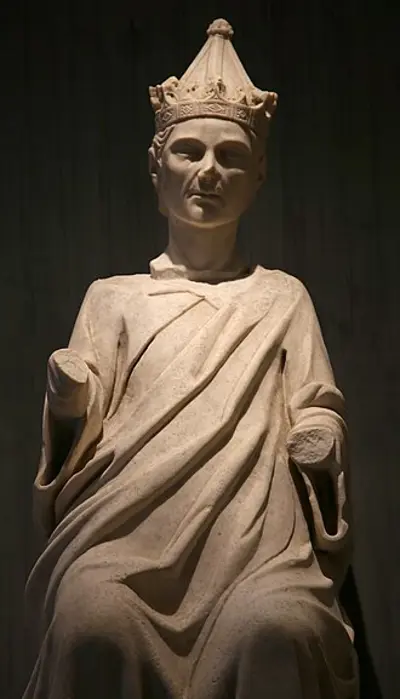
Henry VII was the King of Germany from 1308 and Holy Roman Emperor from 1312. He was the first emperor of the House of Luxembourg. During his brief career he reinvigorated the imperial cause in Italy, which was racked with the partisan struggles between the divided Guelph and Ghibelline factions, and inspired the praise of Dino Compagni and Dante Alighieri. He was the first emperor since the death of Frederick II in 1250, ending the Great Interregnum of the Holy Roman Empire; however, his premature death threatened to undo his life's work. His son, John of Bohemia, failed to be elected as his successor, and there was briefly another anti-king, Frederick the Fair, who contested the rule of Louis IV.
Henry VII is recognized King of the Romans (Holy Roman Emperor) by Pope Clement V.
On July 26, in the year 1309, Henry VII is recognized King of the Romans (Holy Roman Emperor) by Pope Clement V. This event is recorded as a Historical Events event in the history of July 26, one of 435 recorded events on this date across all of history.
Key Facts
- This event took place on July 26, 1309 (AD era).
- It is categorised as a Historical Events event in recorded history.
- Referenced in 3 Wikipedia articles.
- Wikipedia source last updated on 2 July 2026.
On This Date in History 435
This article draws on content from Wikipedia, available under CC BY-SA 4.0.
More on July 26
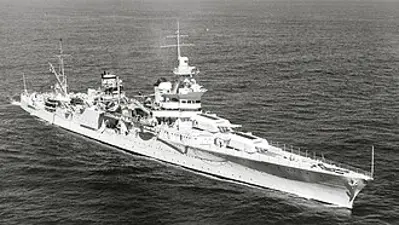
1945
World War II: The USS Indianapolis arrives at Tinian with components and enriched uranium for the Little Boy nuclear…
USS Indianapolis (CL/CA-35) was a Portland-class heavy cruiser of the United States Navy, named for the city of Indianapolis, Indiana. Launched in 1931, she was the flagship of th…
World War II: The USS Indianapolis arrives at Tinian with components and enriched uranium for the Little Boy nuclear…
1944
World War II: The Red Army enters Lviv, a major city in western Ukraine, capturing it from the Nazis. Only 300 Jews…
The Workers' and Peasants' Red Army, often referred by its shortened name as the Red Army, was the army and air force of the Russian Soviet Republic and, from 1922, the Soviet Uni…
World War II: The Red Army enters Lviv, a major city in western Ukraine, capturing it from the Nazis. Only 300 Jews…
1941
85 years ago
World War II: Battle of Grand Harbour, British forces on Malta destroy an attack by the Italian Decima Flottiglia MAS.…
World War II, or the Second World War, was a global conflict between two coalitions: the Allies and the Axis powers. Nearly all of the world's countries participated. World War II…
World War II: Battle of Grand Harbour, British forces on Malta destroy an attack by the Italian Decima Flottiglia MAS.…

1941
85 years ago
World War II: In response to the Japanese occupation of French Indochina, the United States, Britain and the…
French Indochina, officially known as the Indochinese Union and after 1941 as the Indochinese Federation, was a group of French dependent territories in Southeast Asia from 1887 t…
World War II: In response to the Japanese occupation of French Indochina, the United States, Britain and the…
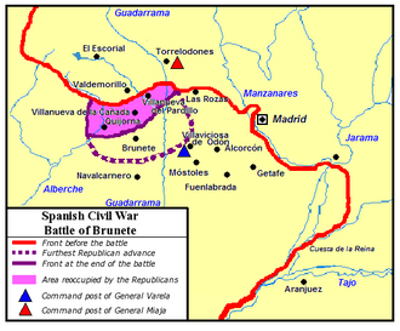
1937
Spanish Civil War: End of the Battle of Brunete with the Nationalist victory.
The Battle of Brunete, fought 24 kilometres (15 mi) west of Madrid, was a Republican attempt to alleviate the pressure exerted by the Nationalists on the capital and on the north …
Spanish Civil War: End of the Battle of Brunete with the Nationalist victory.

1936
90 years ago
Spanish Civil War: Germany and Italy decide to intervene in the war in support for Francisco Franco and the…
The Spanish Civil War was fought from 1936 to 1939 between the Republicans and the Nationalist rebels. Republicans loyal to the left-leaning Popular Front government of the Second…
Spanish Civil War: Germany and Italy decide to intervene in the war in support for Francisco Franco and the…

Comments 0
Sign in to join the discussion.