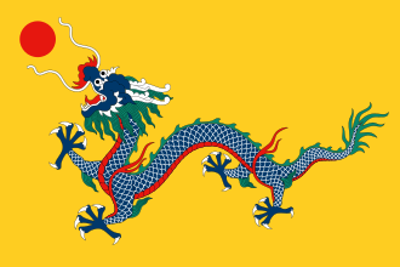
The Qing dynasty, officially the Great Qing, also known as the Qing Empire or Qing China, was a Manchu-led imperial dynasty of China and an early modern empire in East Asia which existed from 1636/1644 to 1912. The last imperial dynasty in Chinese history, the Qing dynasty was preceded by the Ming dynasty and succeeded by the Republic of China. At the height of its power, the empire stretched from the Sea of Japan in the east to the Pamir Mountains in the west, and from the Mongolian Plateau in the north to the South China Sea in the south. Originally emerging from the Later Jin dynasty founded in 1616 and proclaimed in Shenyang in 1636, the dynasty seized control of the Ming capital Beijing and North China in 1644, traditionally considered the start of the dynasty's rule. The dynasty lasted until the Xinhai Revolution of October 1911 led to the abdication of the last emperor in February 1912. The multi-ethnic Qing dynasty assembled the territorial base for modern China. The Qing controlled the most territory of any dynasty in Chinese history, and in 1790 was the fourth-largest empire in world history to that point. It was also the most populous state at the time, with over 426 million citizens in 1907.
Qing dynasty regent Dorgon issues an edict ordering all Han Chinese men to shave their forehead and braid the rest of their hair into a queue identical to those of the Manchus.
On July 21, in the year 1645, Qing dynasty regent Dorgon issues an edict ordering all Han Chinese men to shave their forehead and braid the rest of their hair into a queue identical to those of the Manchus. This event is recorded as a Historical Events event in the history of July 21, one of 430 recorded events on this date across all of history.
Key Facts
- This event took place on July 21, 1645 (AD era).
- It is categorised as a Historical Events event in recorded history.
- Referenced in 5 Wikipedia articles.
- The event is associated with a specific geographical location (see map below).
- Wikipedia source last updated on 16 July 2026.
On This Date in History 430
This article draws on content from Wikipedia, available under CC BY-SA 4.0.
More on July 21
Canadian Pacific Air Lines Flight 3505 disappears while flying from Vancouver to Tokyo. The aircraft and its 37…
Canadian Pacific Air Lines Flight 3505 was a scheduled flight operated by Canadian Pacific Air Lines for the United Nations from Vancouver, Canada, to Tokyo, Japan. On 21 July 195…
Canadian Pacific Air Lines Flight 3505 disappears while flying from Vancouver to Tokyo. The aircraft and its 37…

The United States Senate ratifies the North Atlantic Treaty.
The United States Senate is a chamber of the bicameral United States Congress; it is the upper house, and the U.S. House of Representatives is the lower house. Together, the Senat…
The United States Senate ratifies the North Atlantic Treaty.

World War II: Battle of Guam: American troops land on Guam, starting a battle that will end on August 10.
World War II, or the Second World War, was a global conflict between two coalitions: the Allies and the Axis powers. Nearly all of the world's countries participated. World War II…
World War II: Battle of Guam: American troops land on Guam, starting a battle that will end on August 10.
World War II: Claus von Stauffenberg and four fellow conspirators are executed for the July 20 plot to assassinate…
Claus Philipp Maria Justinian Schenk Graf von Stauffenberg was a German army officer who is best known for his failed attempt on 20 July 1944 to assassinate Adolf Hitler at the Wo…
World War II: Claus von Stauffenberg and four fellow conspirators are executed for the July 20 plot to assassinate…

Spanish Civil War: The Central Committee of Antifascist Militias of Catalonia is constituted, establishing an…
The Spanish Civil War was fought from 1936 to 1939 between the Republicans and the Nationalist rebels. Republicans loyal to the left-leaning Popular Front government of the Second…
Spanish Civil War: The Central Committee of Antifascist Militias of Catalonia is constituted, establishing an…

Scopes Trial: In Dayton, Tennessee, high school biology teacher John T. Scopes is found guilty of teaching human…
The State of Tennessee v. John Thomas Scopes, commonly known as the Scopes trial or Scopes Monkey Trial, was an American legal case from July 10 to July 21, 1925, in which a high …
Scopes Trial: In Dayton, Tennessee, high school biology teacher John T. Scopes is found guilty of teaching human…

Comments 0
Sign in to join the discussion.