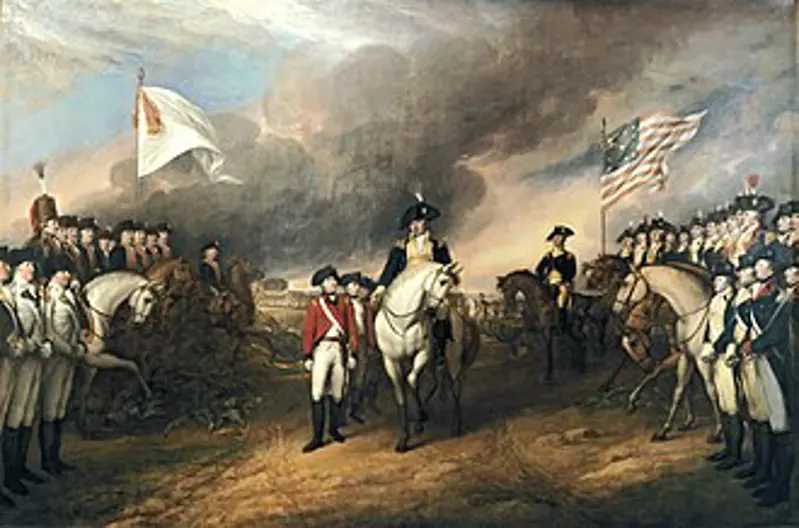
The American Revolutionary War, also known as the Revolutionary War or American War of Independence, was the armed conflict that comprised the final eight years of the broader American Revolution, in which American Patriot forces organized as the Continental Army and commanded by George Washington defeated the British Army. The conflict was fought in North America, the Caribbean, and the Atlantic Ocean. The war's outcome seemed uncertain for most of the war, but Washington and the Continental Army's decisive victory in the Siege of Yorktown in 1781 led King George III and the Kingdom of Great Britain to negotiate an end to the war. In 1783, in the Treaty of Paris, the British monarchy acknowledged the independence of the Thirteen Colonies, leading to the establishment of the United States as an independent and sovereign nation.
American Revolutionary War: A small Colonial militia led by Ethan Allen and Colonel Benedict Arnold captures Fort Ticonderoga.
On May 10, in the year 1775, American Revolutionary War: A small Colonial militia led by Ethan Allen and Colonel Benedict Arnold captures Fort Ticonderoga. This event is recorded as a Historical Events event in the history of May 10, one of 272 recorded events on this date across all of history.
Key Facts
- This event took place on May 10, 1775 (AD era).
- It is categorised as a Historical Events event in recorded history.
- Referenced in 4 Wikipedia articles.
- Wikipedia source last updated on 6 May 2026.
On This Date in History 272
This article draws on content from Wikipedia, available under CC BY-SA 4.0.
More on May 10
Temür, Khagan of the Mongols, is enthroned as Emperor of the Yuan dynasty
Öljeyitü Khan, born Temür, also known by his temple name as the Emperor Chengzong of Yuan, was the second emperor of the Yuan dynasty of China, ruling from 10 May 1294 to 10 Febru…
Temür, Khagan of the Mongols, is enthroned as Emperor of the Yuan dynasty
Scottish nobles recognize the authority of Edward I of England pending the selection of a king
Nobility is a social class found in many societies that have an aristocracy. It is normally appointed by and ranked immediately below royalty. Nobility has often been an estate of…
Scottish nobles recognize the authority of Edward I of England pending the selection of a king
Alberic II of Spoleto arranges the election of pope Agapetus II following the death of Pope Marinus II
Alberic II was princeps of Rome from 932 to 954. He controlled the papacy during his reign and the five popes after Pope John XI were appointed by him. A member of the House of Th…
Alberic II of Spoleto arranges the election of pope Agapetus II following the death of Pope Marinus II
A sunspot is observed by Han dynasty astronomers during the reign of Emperor Cheng of Han, one of the earliest dated sun
Sunspots are temporary spots on the Sun's surface that are darker than the surrounding area. They are regions of reduced surface temperature caused by concentrations of magnetic f…
A sunspot is observed by Han dynasty astronomers during the reign of Emperor Cheng of Han, one of the earliest dated sun

Start of the May 2024 solar storms, the most powerful set of geomagnetic storms since the 2003 Halloween solar storms
The solar storms of May 2024 were a series of powerful solar storms with extreme solar flares and geomagnetic storm components that occurred from 10 to 13 May 2024 during solar cy…
Start of the May 2024 solar storms, the most powerful set of geomagnetic storms since the 2003 Halloween solar storms
Queen Elizabeth II misses the State Opening of Parliament for the first time in 59 years
Elizabeth II was Queen of the United Kingdom and other Commonwealth realms from 6 February 1952 until her death in 2022. She was queen regnant of 32 sovereign states during her li…
Queen Elizabeth II misses the State Opening of Parliament for the first time in 59 years
Comments 0
Sign in to join the discussion.