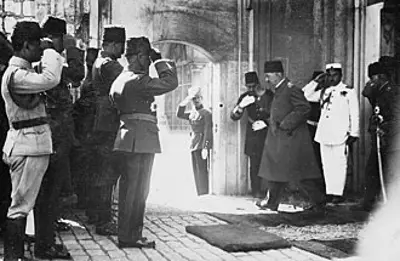
The Grand National Assembly of Turkey abolished the monarchy on 1 November 1922 and ended the Ottoman Empire, which had lasted from c. 1299. On 11 November 1922, at the Conference of Lausanne, the sovereignty of the Grand National Assembly exercised by the Government in Angora over Turkey was recognized. The last sultan, Mehmed VI, departed the Ottoman capital, Constantinople, on 17 November 1922 aboard HMS Malaya. The legal position was solidified with the signing of the Treaty of Lausanne on 24 July 1923 and the proclamation of the Republic of Turkey on 29 October 1923. In March 1924 the Caliphate was abolished, marking the end of the last remnant of the former monarchy.
Abolition of the Ottoman sultanate: The last sultan of the Ottoman Empire, Mehmed VI, abdicates.
On November 1, in the year 1922, Abolition of the Ottoman sultanate: The last sultan of the Ottoman Empire, Mehmed VI, abdicates. This event is recorded as a Historical Events event in the history of November 1, one of 467 recorded events on this date across all of history.
Key Facts
- This event took place on November 1, 1922 (AD era).
- It is categorised as a Historical Events event in recorded history.
- Referenced in 3 Wikipedia articles.
- Wikipedia source last updated on 30 October 2026.
On This Date in History 467
This article draws on content from Wikipedia, available under CC BY-SA 4.0.
More on November 1

1856
170 years ago
The British Empire declare war on Iran following Naser al-Din Shah's capture of Herat.
The British Empire comprised the dominions, colonies, protectorates, mandates, and other territories ruled or administered by the United Kingdom and its predecessor states. It beg�

1848
In Boston, Massachusetts, the first medical school for women, Boston Female Medical School (which later merged with…
Boston is the capital and most populous city of the U.S. state of Massachusetts. It serves as a cultural and financial center of New England, a region of the Northeastern United S�
1814
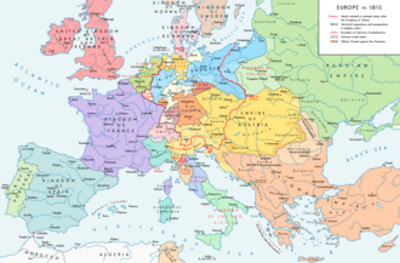
Congress of Vienna opens to re-draw the European political map after the defeat of France in the Napoleonic Wars.
The Congress of Vienna of 1814–1815 was a series of international diplomatic meetings to discuss and agree upon a possible new layout of the European political and constitutional �
1805
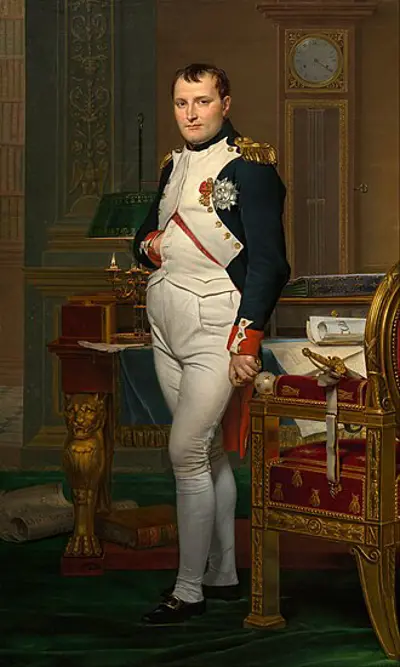
Napoleon Bonaparte invades Austria during the War of the Third Coalition.
Napoleon Bonaparte, was Emperor of the French from 18 May 1804 until his first abdication in 1814, with a brief restoration during the Hundred Days in 1815. He rose to prominence �
1800
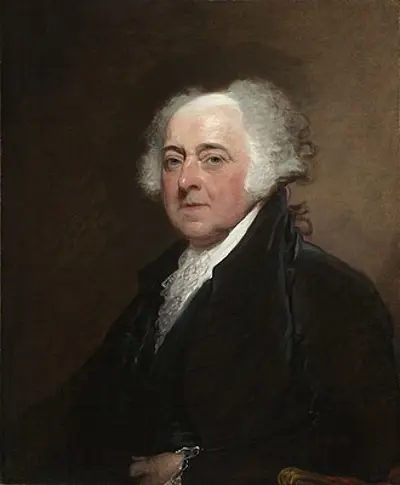
John Adams becomes the first President of the United States to live in the Executive Mansion (later renamed the White…
John Adams was a Founding Father and the second president of the United States from 1797 to 1801. Before his presidency, he was a leader of the American Revolution that achieved i�
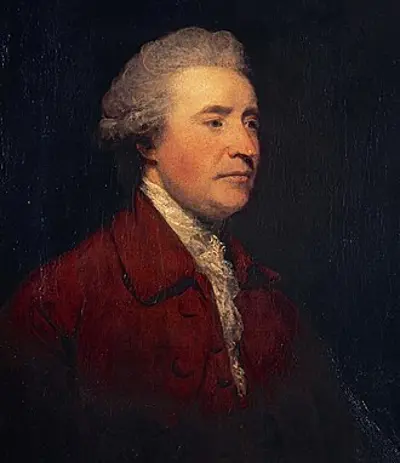
1790
Edmund Burke publishes Reflections on the Revolution in France, in which he predicts that the French Revolution will…
Edmund Burke was an Anglo-Irish writer, philosopher, and politician who is widely credited as the founder of the cultural and political philosophy of conservatism. Regarded as one�

Comments 0
Sign in to join the discussion.