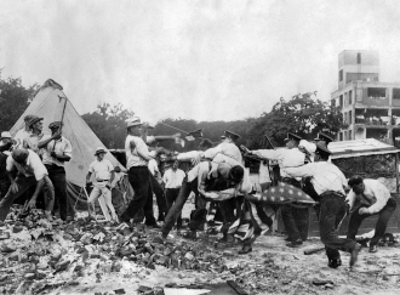
The Bonus Army, a group of 43,000 demonstrators—17,000 veterans of U.S. involvement in World War I, their families, and affiliated groups—gathered in Washington, D.C., in mid-1932 to demand early cash redemption of their service-bonus certificates. Organizers called the demonstrators the Bonus Expeditionary Force (B.E.F.), to echo the name of World War I's American Expeditionary Forces, while the media referred to them as the "Bonus Army" or as "Bonus Marchers". The demonstrators were led by Walter W. Waters, a former sergeant. Many of the war veterans had been out of work during the early years of the Great Depression. The World War Adjusted Compensation Act of 1924 had awarded all U.S. World War I veterans "bonuses" in the form of certificates which they could not redeem until 1945. Each certificate, issued to a qualified veteran soldier, bore a face value equal to the soldier's promised payment with compound interest. The principal demand of the Bonus Army was the immediate cash payment of their certificates.
Bonus Army: Around a thousand World War I veterans amass at the United States Capitol as the U.S. Senate considers a bill that would give them certain benefits.
On June 17, in the year 1932, Bonus Army: Around a thousand World War I veterans amass at the United States Capitol as the U.S. Senate considers a bill that would give them certain benefits. This event is recorded as a Historical Events event in the history of June 17, one of 434 recorded events on this date across all of history.
Key Facts
- This event took place on June 17, 1932 (AD era).
- It is categorised as a Historical Events event in recorded history.
- Referenced in 3 Wikipedia articles.
- The event is associated with a specific geographical location (see map below).
- Wikipedia source last updated on 25 May 2026.
On This Date in History 434
This article draws on content from Wikipedia, available under CC BY-SA 4.0.
More on June 17
Foundation of Anglo-Corsican Kingdom
The Anglo-Corsican Kingdom, also known officially as the Kingdom of Corsica, was a client state of the Kingdom of Great Britain that existed on the island of Corsica from 1794 to …
Foundation of Anglo-Corsican Kingdom

In France, the Third Estate declares itself the National Assembly
France, officially the French Republic, is a country primarily located in Western Europe. Its overseas regions and territories include French Guiana in South America, Saint Pierre…
In France, the Third Estate declares itself the National Assembly
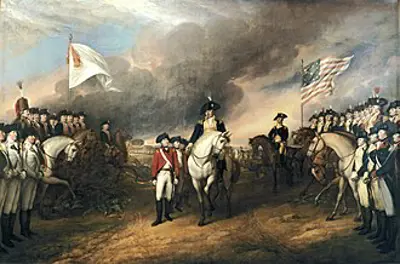
American Revolutionary War: Colonists inflict heavy casualties on British forces while losing the Battle of Bunker Hill
The American Revolutionary War, also known as the Revolutionary War or American War of Independence or simply the American Revolution, was the armed conflict that comprised the fi…
American Revolutionary War: Colonists inflict heavy casualties on British forces while losing the Battle of Bunker Hill
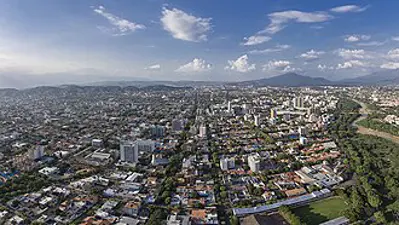
Cúcuta, Colombia, is founded by Juana Rangel de Cuéllar
Cúcuta, officially San José de Cúcuta, is a Colombian municipality, capital of the department of Norte de Santander and nucleus of the Metropolitan Area of Cúcuta. The city is loc…
Cúcuta, Colombia, is founded by Juana Rangel de Cuéllar
Samuel Wallis, a British sea captain, sights Tahiti and is considered the first European to reach the island
Captain Samuel Wallis was a Royal Navy officer and explorer who made the first recorded visit by a European navigator to Tahiti.
Samuel Wallis, a British sea captain, sights Tahiti and is considered the first European to reach the island
French explorers Jacques Marquette and Louis Jolliet reach the Mississippi River and become the first Europeans to make
French people are the individuals who are identified with the country of France, or more broadly, a global sociolinguistic group that share a common connection through the French …
French explorers Jacques Marquette and Louis Jolliet reach the Mississippi River and become the first Europeans to make

Comments 0
Sign in to join the discussion.