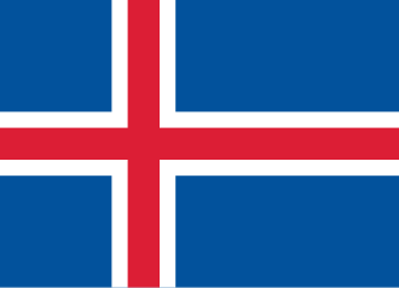
Iceland is a Nordic island country between the Arctic Ocean and the North Atlantic Ocean, located on the Mid-Atlantic Ridge between Europe and North America. It is culturally and politically linked with Europe and is the region's westernmost and most sparsely populated country. Its capital and largest city is Reykjavík, which is home to about 35% of the country's roughly 395,000 residents. The official language of the country is Icelandic. Iceland is on a rift between tectonic plates, and its geologic activity includes geysers and frequent volcanic eruptions. The interior consists of a volcanic plateau with sand and lava fields, mountains and glaciers, and many glacial rivers flow to the sea through the lowlands. Iceland is warmed by the Gulf Stream and has a temperate climate, despite being at a latitude just south of the Arctic Circle. Its latitude and marine influence keep summers chilly, and most of its islands have a polar climate.
Iceland declares independence from Denmark and becomes a republic.
On June 17, in the year 1944, Iceland declares independence from Denmark and becomes a republic. This event is recorded as a Historical Events event in the history of June 17, one of 434 recorded events on this date across all of history.
Key Facts
- This event took place on June 17, 1944 (AD era).
- It is categorised as a Historical Events event in recorded history.
- Referenced in 3 Wikipedia articles.
- The event is associated with a specific geographical location (see map below).
- Wikipedia source last updated on 31 May 2026.
On This Date in History 434
This article draws on content from Wikipedia, available under CC BY-SA 4.0.
More on June 17
Foundation of Anglo-Corsican Kingdom
The Anglo-Corsican Kingdom, also known officially as the Kingdom of Corsica, was a client state of the Kingdom of Great Britain that existed on the island of Corsica from 1794 to …
Foundation of Anglo-Corsican Kingdom

In France, the Third Estate declares itself the National Assembly
France, officially the French Republic, is a country primarily located in Western Europe. Its overseas regions and territories include French Guiana in South America, Saint Pierre…
In France, the Third Estate declares itself the National Assembly
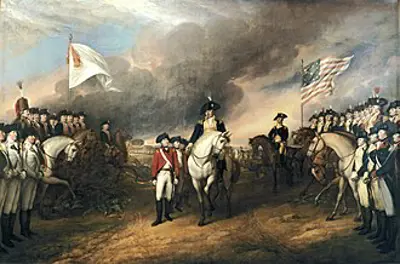
American Revolutionary War: Colonists inflict heavy casualties on British forces while losing the Battle of Bunker Hill
The American Revolutionary War, also known as the Revolutionary War or American War of Independence or simply the American Revolution, was the armed conflict that comprised the fi…
American Revolutionary War: Colonists inflict heavy casualties on British forces while losing the Battle of Bunker Hill
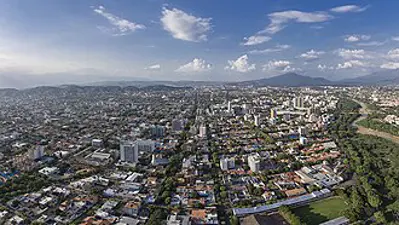
Cúcuta, Colombia, is founded by Juana Rangel de Cuéllar
Cúcuta, officially San José de Cúcuta, is a Colombian municipality, capital of the department of Norte de Santander and nucleus of the Metropolitan Area of Cúcuta. The city is loc…
Cúcuta, Colombia, is founded by Juana Rangel de Cuéllar
Samuel Wallis, a British sea captain, sights Tahiti and is considered the first European to reach the island
Captain Samuel Wallis was a Royal Navy officer and explorer who made the first recorded visit by a European navigator to Tahiti.
Samuel Wallis, a British sea captain, sights Tahiti and is considered the first European to reach the island
French explorers Jacques Marquette and Louis Jolliet reach the Mississippi River and become the first Europeans to make
French people are the individuals who are identified with the country of France, or more broadly, a global sociolinguistic group that share a common connection through the French …
French explorers Jacques Marquette and Louis Jolliet reach the Mississippi River and become the first Europeans to make
Comments 0
Sign in to join the discussion.