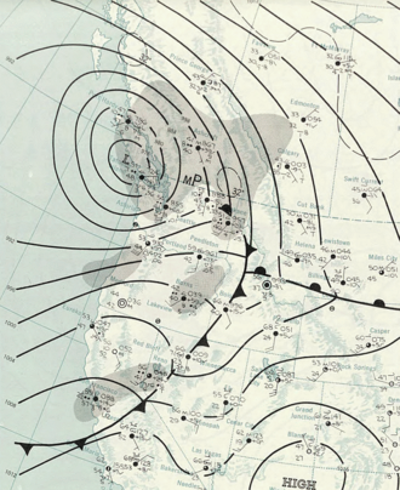
The Columbus Day storm of 1962 was a Pacific Northwest windstorm that struck the West Coast of Canada and the Pacific Northwest coast of the United States on October 12, 1962. Typhoon Freda was the twenty-eighth tropical depression, the twenty-third tropical storm, and the eighteenth typhoon of the 1962 Pacific typhoon season. Freda originated from a tropical disturbance over the Northwest Pacific on September 28. On October 3, the system strengthened into a tropical storm and was given the name Freda, before becoming a typhoon later that day, while moving northeastward. The storm quickly intensified, reaching its peak as a Category 3-equivalent typhoon on October 5, with maximum 1-minute sustained winds of 115 mph (185 km/h) and a minimum central pressure of 948 millibars (28.0 inHg). Freda maintained its intensity for another day, before beginning to gradually weaken, later on October 6. On October 9, Freda weakened into a tropical storm, before transitioning into an extratropical cyclone on the next day. On October 11, Freda turned eastward and accelerated across the North Pacific, before striking the Pacific Northwest on the next day. On October 13, the cyclone made landfall on Washington and Vancouver Island, and then curved northwestward. Afterward, the system moved into Canada and weakened, before being absorbed by another developing storm to the south on October 17.
The Pacific Northwest experiences a cyclone the equal of a Category 3 hurricane, with winds above 150 mph. Forty-six people die.
On October 13, in the year 1962, The Pacific Northwest experiences a cyclone the equal of a Category 3 hurricane, with winds above 150 mph. Forty-six people die. This event is recorded as a Historical Events event in the history of October 13, one of 381 recorded events on this date across all of history.
Key Facts
- This event took place on October 13, 1962 (AD era).
- It is categorised as a Historical Events event in recorded history.
- Referenced in 1 Wikipedia article.
- Wikipedia source last updated on 20 May 2026.
On This Date in History 381
This article draws on content from Wikipedia, available under CC BY-SA 4.0.
More on October 13
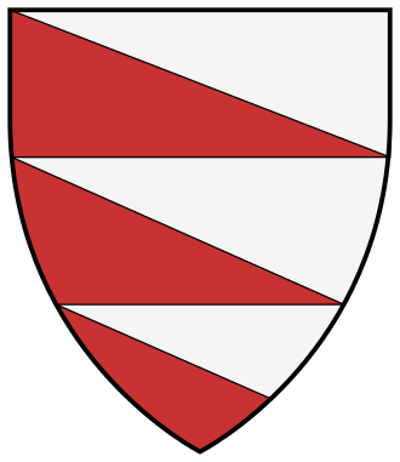
Hungarian forces under Stephen V Báthory decisively defeat an invading Ottoman army in the battle of Breadfield.
Stephen Báthory of Ecsed was a Hungarian commander, 'dapiferorum regalium magister' (1458–?), judge royal (1471–1493), and voivode of Transylvania (1479–1493). He rose to power un…
Hungarian forces under Stephen V Báthory decisively defeat an invading Ottoman army in the battle of Breadfield.
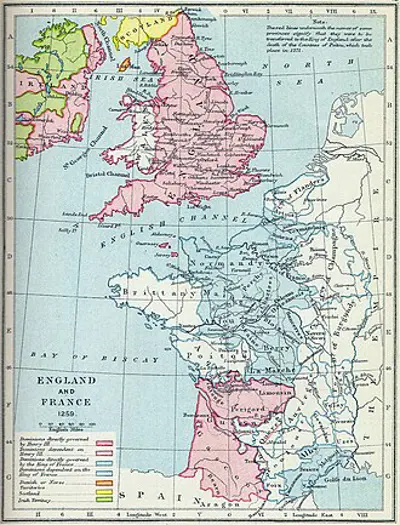
The Provisions of Westminster, a law reform programme resulting out of the conflict of king Henry III of England and…
The Provisions of Westminster of 1259 were part of a series of legislative constitutional reforms that arose out of power struggles between Henry III of England and his barons. Th…
The Provisions of Westminster, a law reform programme resulting out of the conflict of king Henry III of England and…

Kenyan Brigid Kosgei sets a new world record for a woman runner with a time of 2:14:04 at the 2019 Chicago Marathon.
Brigid Jepchirchir Kosgei is a Kenyan long-distance runner who specialises in the marathon. She won the 2018 and 2019 Chicago Marathons, the 2019 and 2020 London Marathons and the…
Kenyan Brigid Kosgei sets a new world record for a woman runner with a time of 2:14:04 at the 2019 Chicago Marathon.

The Maldives announces its decision to withdraw from the Commonwealth of Nations.
The Maldives, officially the Republic of Maldives, and historically known as the Maldive Islands, is an archipelagic country in South Asia, located in the Indian Ocean, near the s…
The Maldives announces its decision to withdraw from the Commonwealth of Nations.
A stampede occurs in India during the Hindu festival Navratri, killing 115 and injuring more than 110.
On 13 October 2013, during the Hindu festival of Navratri, a stampede broke out on a bridge near the Ratangarh Mata Temple in Datia district, Madhya Pradesh, India, killing 115 pe…
A stampede occurs in India during the Hindu festival Navratri, killing 115 and injuring more than 110.
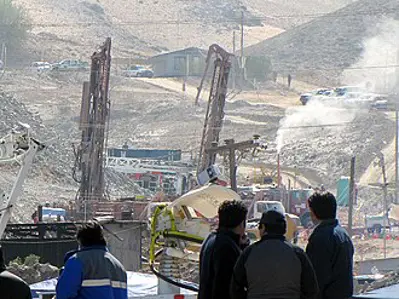
The mining accident in Copiapó, Chile ends as all 33 trapped miners arrive at the surface after a record 69 days…
A mining accident began on 5 August 2010 with a cave-in at the San José copper–gold mine in the Atacama Desert, 45 kilometers (28 mi) north of the regional capital of Copiapó, in …
The mining accident in Copiapó, Chile ends as all 33 trapped miners arrive at the surface after a record 69 days…

Comments 0
Sign in to join the discussion.