
Tanganyika was a sovereign state, comprising the mainland part of present-day Tanzania, that existed from 1961 until 1964. It first gained independence from the United Kingdom on 9 December 1961 as a Commonwealth realm headed by Queen Elizabeth II before becoming a republic within the Commonwealth of Nations as the Republic of Tanganyika a year later. After signing the Articles of Union on 22 April 1964 and passing an Act of Union on 25 April, Tanganyika officially joined with the People's Republic of Zanzibar to form the United Republic of Tanganyika and Zanzibar on Union Day, 26 April 1964. The new state changed its name to the United Republic of Tanzania within a year.
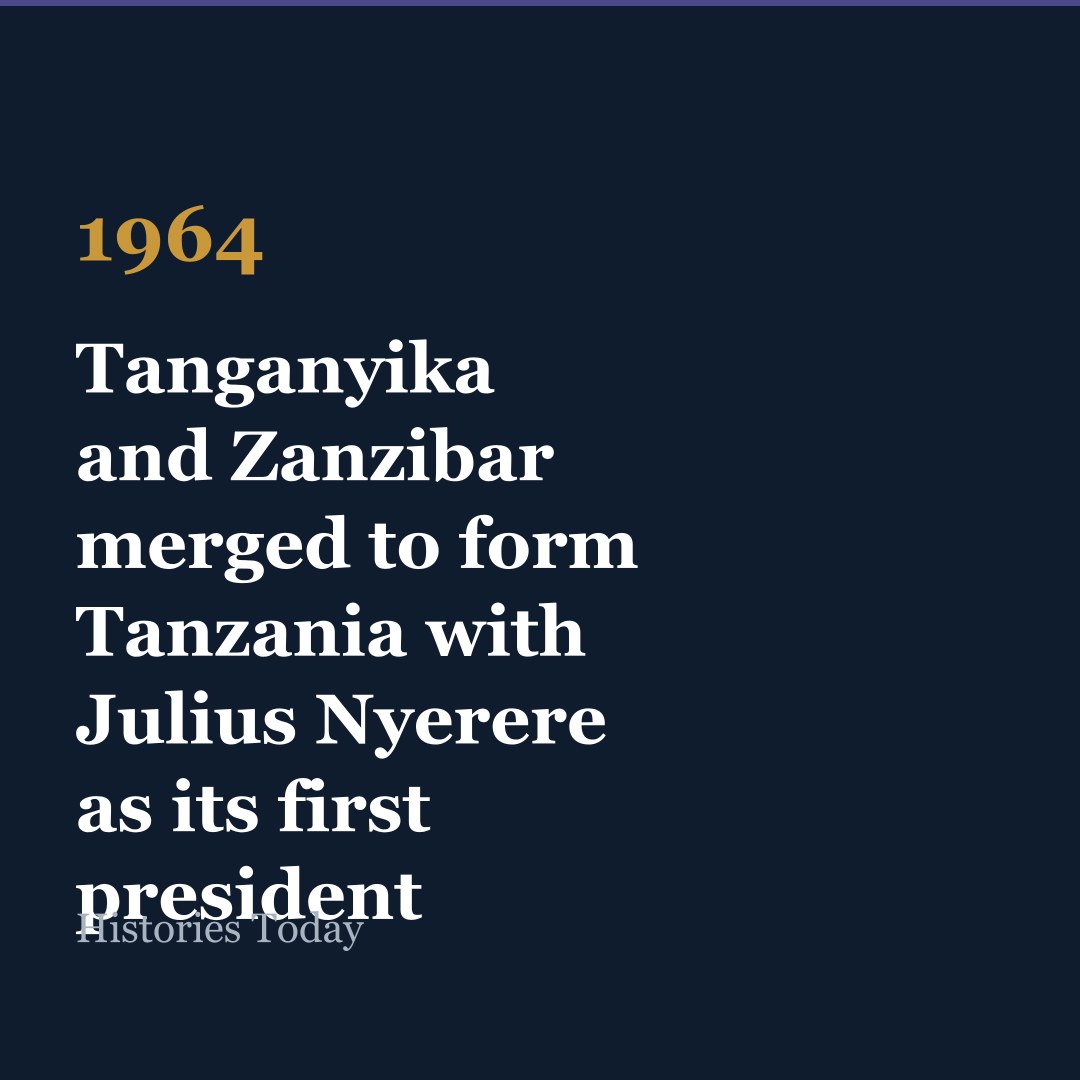
Tanganyika and Zanzibar merged to form Tanzania with Julius Nyerere as its first president.
On April 26, in the year 1964, Tanganyika and Zanzibar merged to form Tanzania with Julius Nyerere as its first president. This event is recorded as a Selected Events event in the history of April 26, one of 377 recorded events on this date across all of history.
Key Facts
- This event took place on April 26, 1964 (AD era).
- It is categorised as a Selected Events event in recorded history.
- Referenced in 4 Wikipedia articles.
- Wikipedia source last updated on 28 March 2026.
On This Date in History 377
This article draws on content from Wikipedia, available under CC BY-SA 4.0.
More on April 26

2017
The Shandong was launched for the People's Liberation Army Navy, China's first domestically built aircraft carrier
Shandong is a Chinese aircraft carrier that was launched on 26 April 2017 for the People's Liberation Army Navy (PLAN) of the People's Republic of China. She is the country's firs…
The Shandong was launched for the People's Liberation Army Navy, China's first domestically built aircraft carrier
2007
Controversy surrounding the relocation of the Bronze Soldier of Tallinn, a Soviet Red Army World War II memorial in Tall
The Bronze Soldier is the informal name of a controversial Soviet World War II war memorial in Tallinn, Estonia, built at the site of several war graves, which were relocated to …
Controversy surrounding the relocation of the Bronze Soldier of Tallinn, a Soviet Red Army World War II memorial in Tall

2002
An expelled student murdered sixteen people and wounded seven others before committing suicide at the Gutenberg-Gymnasiu
The Erfurt school massacre was a mass shooting that occurred on 26 April 2002 at the Gutenberg-Gymnasium, a secondary school in Erfurt, Thuringia, Germany. 19-year-old expelled st…
An expelled student murdered sixteen people and wounded seven others before committing suicide at the Gutenberg-Gymnasiu

1999
The CIH virus activated widely, damaging hundreds of thousands of computers and causing hundreds of millions of dollars
CIH, also known as the Chernobyl virus, is a computer virus that targets computers running the Windows 9x family of operating systems. There are several variants, with different t…
The CIH virus activated widely, damaging hundreds of thousands of computers and causing hundreds of millions of dollars

1994
Just before landing at Nagoya Airport, Japan, the copilot of China Airlines Flight 140 inadvertently triggered the takeo
Nagoya Airfield , also known as Komaki Airport or Nagoya Airport, is an airport within the local government areas of Toyoyama, Komaki, Kasugai and Nagoya in Aichi Prefecture, Japa…
Just before landing at Nagoya Airport, Japan, the copilot of China Airlines Flight 140 inadvertently triggered the takeo

1989
An editorial was published in the People's Daily denouncing the growing unrest in Tiananmen Square in Beijing which woul
The April 26 Editorial was a front-page article published in People's Daily on April 26, 1989, during the Tiananmen Square protests. The editorial effectively defined the student …
An editorial was published in the People's Daily denouncing the growing unrest in Tiananmen Square in Beijing which woul
Comments 0
Sign in to join the discussion.