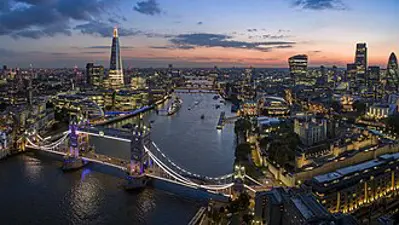
London is the capital and largest city of England and the United Kingdom, with a population of 9.1 million people in 2024. Its wider metropolitan area is the largest in Western Europe, with a population of 15.4 million. London stands on the River Thames in southeast England, at the head of a 50-mile (80 km) tidal estuary down to the North Sea, and has been a major settlement for nearly 2,000 years. Its ancient core and financial centre, the City of London, was founded by the Romans as Londinium and has retained its medieval boundaries. The City of Westminster, to the west of the City of London, has been the site of the national government and parliament for centuries. London grew rapidly in the 19th century, becoming the world's largest city at the time. Since the 19th century the name "London" has referred to the metropolis around the City of London, historically split among the counties of Middlesex, Essex, Surrey, Kent and Hertfordshire. Since 1965 it has largely comprised the administrative area of Greater London, governed by 33 local authorities and the Greater London Authority.
In London, the England national football team won the FIFA World Cup, winning the final against West Germany 4–2 after extra time.
On July 30, in the year 1966, In London, the England national football team won the FIFA World Cup, winning the final against West Germany 4–2 after extra time. This event is recorded as a Selected Events event in the history of July 30, one of 383 recorded events on this date across all of history.
Key Facts
- This event took place on July 30, 1966 (AD era).
- It is categorised as a Selected Events event in recorded history.
- Referenced in 5 Wikipedia articles.
- The event is associated with a specific geographical location (see map below).
- Wikipedia source last updated on 19 July 2026.
On This Date in History 383
This article draws on content from Wikipedia, available under CC BY-SA 4.0.
More on July 30

In Pakistan, IS–KP kill over 60 people in a suicide bombing at a political rally in Khar.
The Islamic State – Khorasan Province is a regional branch of the Salafi jihadist group Islamic State (IS) active in Central and South Asia, primarily Afghanistan, Pakistan, Tajik…
In Pakistan, IS–KP kill over 60 people in a suicide bombing at a political rally in Khar.
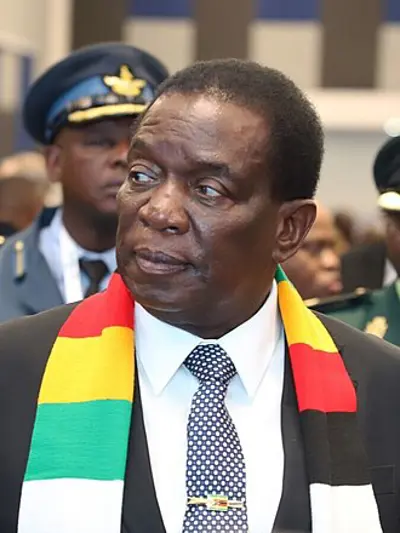
Emmerson Mnangagwa (pictured) was elected to his first full term as president, having served as leader since the 2017…
Emmerson Dambudzo Mnangagwa is a Zimbabwean politician who has served as the president of Zimbabwe since 2017. His rule has been described as a dictatorship. A member of ZANU–PF a…
Emmerson Mnangagwa (pictured) was elected to his first full term as president, having served as leader since the 2017…
More than 150 people died after heavy rains triggered a landslide in the village of Malin in Maharashtra, India.
On 30 July 2014, a landslide occurred in the village of Malin in the Ambegaon taluka of the Pune district in Maharashtra, India. The landslide, which hit early in the morning whil…
More than 150 people died after heavy rains triggered a landslide in the village of Malin in Maharashtra, India.

A train fire killed 32 passengers and injured 27 on the Tamil Nadu Express in Andhra Pradesh, India.
The Nellore train fire occurred on 30 July 2012, when the Chennai-bound Tamil Nadu Express train caught fire at 4:22 am near Nellore, Andhra Pradesh, India. At least 32 passengers…
A train fire killed 32 passengers and injured 27 on the Tamil Nadu Express in Andhra Pradesh, India.
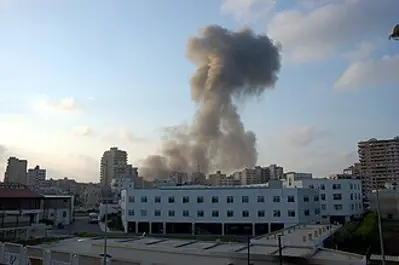
Lebanon War: The Israeli Air Force attacked a three-story building near the Lebanese village of Qana, killing at least…
The 2006 Lebanon War was a 34-day armed conflict in Lebanon, fought between Hezbollah and Israel. The war started on 12 July 2006 and continued until a United Nations-brokered cea…
Lebanon War: The Israeli Air Force attacked a three-story building near the Lebanese village of Qana, killing at least…
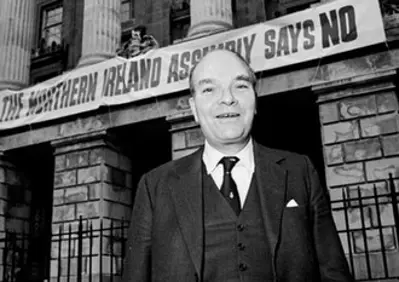
British Conservative member of Parliament Ian Gow was killed outside his home in a car bombing by the Provisional…
The Conservative and Unionist Party, commonly known as the Conservative Party and colloquially as the Tories, is a political party in the United Kingdom. It sits on the centre-rig…
British Conservative member of Parliament Ian Gow was killed outside his home in a car bombing by the Provisional…
Comments 0
Sign in to join the discussion.