World War II: Charles de Gaulle gave his Appeal of 18 June speech, often considered to be the origin of the French Resis
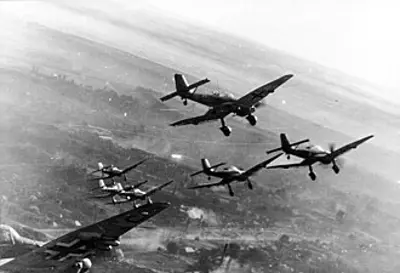
World War II: Charles de Gaulle gave his Appeal of 18 June speech, often considered to be the origin of the French Resistance.
2110 results for “William R. Moses” — type: selected (808 ms)
World War II: Charles de Gaulle gave his Appeal of 18 June speech, often considered to be the origin of the French Resistance.
Third Silesian War: The Austrian victory at the Battle of Kolín forced Prussian leader Frederick the Great to give up the Siege of Prague and retreat to Saxony.
Nguyễn Cao Kỳ, the commander of the South Vietnam Air Force, was appointed prime minister at the head of a military regime.
A 6.0 Mw earthquake (aftermath pictured) caused up to NZ$6 billion of additional damage to Christchurch, New Zealand, which was still recovering from an earthquake four months earlier.
Leo X issued the papal bull Exsurge Domine, censuring 41 propositions from Martin Luther's Ninety-five Theses and subsequent writings, and threatening him with excommunication unless he recanted.
During a general strike in Winnipeg, Canada, members of the Royal North-West Mounted Police attacked a crowd of strikers, armed with clubs and revolvers.
A magnitude-6.5 earthquake struck northwestern Iran, killing at least 230 people and injuring 1,300 others; the official response, perceived to be slow, later caused widespread public anger.
Former British Liberal Party leader Jeremy Thorpe was acquitted of conspiracy to murder Norman Scott, who had accused Thorpe of having a relationship with him.
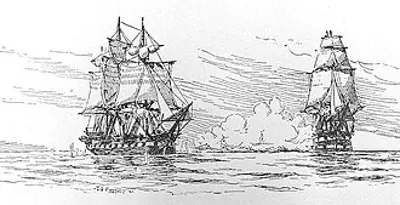
The British warship HMS Leopard pursued and attacked the American frigate USS Chesapeake (pictured) in the belief that the crew of the latter included deserters from the Royal Navy.
Croatian War of Independence: The Battle of the Miljevci Plateau ended after a failed counterattack by forces of the Republic of Serbian Krajina against the Croatian Army who had captured the plateau.
President Richard Nixon signed Title IX (co-author Patsy Mink pictured) into law as part of the Education Amendments, prohibiting gender discrimination in any educational program receiving U.S. feder�
The U.S. Navy's first two fast battleships, North Carolina and Washington, of the North Carolina class, were respectively ordered from the New York and Philadelphia Naval Shipyards.
World War II: U.S. Navy and Royal Navy ships bombarded Cherbourg, France, to support U.S. Army units engaged in the Battle of Cherbourg.
The U.S. Supreme Court ruled in Obergefell v. Hodges that the right of same-sex couples to marry is guaranteed by the Fourteenth Amendment.
The U.S. Supreme Court granted federal recognition to same-sex marriage when it overturned the Defense of Marriage Act.
J. K. Rowling's Harry Potter and the Philosopher's Stone, the first book in the Harry Potter fantasy novel series, is released.
The Japanese space probe Hayabusa2 (artist's impression pictured) arrived at the asteroid Ryugu to collect samples for return to Earth.
�n War of Independence: As the Yugoslav Army moved into Osijek, Croatia, a civilian attempted to halt them by placing his car in the path of a tank, becoming a symbol of Croatian resistance in the war.
A. E. J. Collins (pictured) scored 628 runs not out, the highest recorded score in cricket until being surpassed in 2016.
One day after surrendering at the Battle of Hakodate, Enomoto Takeaki turned the fort of Goryōkaku over to Japanese forces, signaling the collapse of the Republic of Ezo.