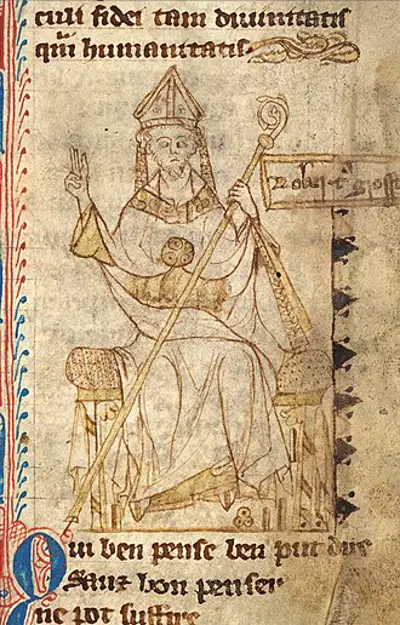
Theobald I of Navarre (born 1201)
Theobald I, also called the Troubadour and the Posthumous, was Count of Champagne from birth and King of Navarre from 1234. He initiated the Barons' Crusade, was famous as a trouvè…
Theobald I of Navarre (born 1201)
Explore 38 historical events from 1250β1259.
Theobald I, also called the Troubadour and the Posthumous, was Count of Champagne from birth and King of Navarre from 1234. He initiated the Barons' Crusade, was famous as a trouvè…
Theobald I of Navarre (born 1201)
Nichiren was a Japanese Buddhist monk and philosopher of the Kamakura period. His teachings form the basis of Nichiren Buddhism, a unique branch of Japanese Mahayana Buddhism base…
The Japanese monk Nichiren declared the mantra Namu Myōhō Renge Kyō, now a central part of Nichiren Buddhism
Pope Innocent IV, born Sinibaldo Fieschi, was head of the Catholic Church and ruler of the Papal States from 25 June 1243 to his death in 1254.
Pope Innocent IV issues the papal bull ad extirpanda, which authorizes, but also limits, the torture of heretics in the
Alfonso X was King of Castile, León and Galicia from 1 June 1252 until his death in 1284. During the election of 1257, a dissident faction chose him to be king of Germany on 1 Apri…
Alfonso X is proclaimed king of Castile and León
Ferdinand III, called the Saint, was King of Castile from 1217 and King of León from 1230 as well as King of Galicia from 1231. He was the son of Alfonso IX of León and Berengaria …
Ferdinand III, king of Castile and León (born 1199)
Robert Passelewe was a medieval Bishop of Chichester elect as well as being a royal clerk and Archdeacon of Lewes.
Robert Passelewe, Bishop of Chichester
Otto I of Brunswick-Lüneburg, a member of the House of Welf, was the first duke of Brunswick-Lüneburg from 1235 until his death. He is called Otto the Child to distinguish him from…
Otto I, Duke of Brunswick-Lüneburg
Abel Valdemarsen was Duke of Schleswig from 1232 to 1252 and King of Denmark from 1250 until his death in 1252. He was the son of Valdemar II by his second wife, Berengaria of Port…
Abel, King of Denmark (born 1218)
Pope Innocent IV, born Sinibaldo Fieschi, was head of the Catholic Church and ruler of the Papal States from 25 June 1243 to his death in 1254.
Pope Innocent IV issued the papal bull Ad extirpanda, authorizing the use of torture on heretics during the Medieval Inq
The Order of the Brothers of the Blessed Virgin Mary of Mount Carmel, known as the Carmelites or sometimes by synecdoche known simply as Carmel, is a mendicant order in the Catholi…
Celebrated by the Carmelite Order–but doubted by modern historians–as the day when Saint Simon Stock had a vision of…
William III was the lord of Dampierre from 1231 and count of Flanders from 1247 until his death. He was the son of William II of Dampierre and Margaret II of Flanders.
William III of Dampierre, Count of Flanders
Mamluk or Mamaluk were non-Arab, ethnically diverse enslaved mercenaries, slave-soldiers, and freed slaves who were assigned high-ranking military and administrative duties in the …
Mamluks under Baybars murder the Ayyubid sultan Turanshah for fear of losing their privileges
Peter I, also known as Peter Mauclerc and Peter of Dreux, reigned as Duke of Brittany alongside his wife Alix from 1213 to 1221, and was regent of the duchy for his minor son John …
Peter I, duke of Brittany
Theresa of Portugal was Queen of Léon as the first wife of her first cousin King Alfonso IX of León. When her marriage was annulled because of consanguinity, she retired to a conve…
Theresa of Portugal, Queen of León