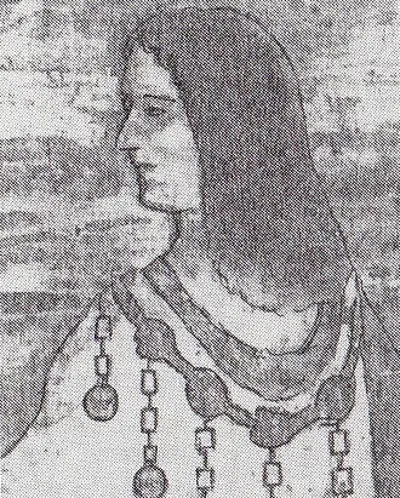
Behnam Hadloyo becomes Syriac Orthodox Patriarch of Mardin.
Ignatius Behnam Hadloyo was the Patriarch of Antioch and head of the Syriac Orthodox Church from 1445 until his death in 1454.
Behnam Hadloyo becomes Syriac Orthodox Patriarch of Mardin.
Explore 44 historical events from 1410β1419.
Ignatius Behnam Hadloyo was the Patriarch of Antioch and head of the Syriac Orthodox Church from 1445 until his death in 1454.
Behnam Hadloyo becomes Syriac Orthodox Patriarch of Mardin.
Count Reinhard III of Hanau was Count of Hanau from 1451 until his death. He was the son of Count Reinhard II of Hanau and his wife, Catherine of Nassau-Beilstein.
Reinhard III, Count of Hanau (1451–1452) (died 1452)
Ludovico III Gonzaga of Mantua, known as the Turk, also spelled Lodovico was the ruler of the Italian city of Mantua from 1444 to his death in 1478.
Ludovico III Gonzaga, Marquis of Mantua, Italian ruler (died 1478)
Gian Maria Visconti was the second Visconti Duke of Milan, the son of Gian Galeazzo Visconti and Caterina Visconti. He was known to be cruel and was eventually assassinated. He had…
Gian Maria Visconti, Duke of Milan (born 1388)
Charles VI, nicknamed the Beloved and in the 19th century, the Mad, was King of France from 1380 until his death in 1422. He is known for his mental illness and psychotic episodes …
King Charles VI grants a monopoly for the ripening of Roquefort cheese to the people of Roquefort-sur-Soulzon, as they h
The Ming dynasty, officially the Great Ming, was an imperial dynasty of China that ruled from 1368 to 1644, following the collapse of the Mongol-led Yuan dynasty. The Ming was the …
Ming China's Admiral Zheng He returns to Nanjing after the third treasure voyage and presents the Sinhalese king,…
The Battle of Harlaw was a Scottish clan battle fought on 24 July 1411 just north of Inverurie in Aberdeenshire. It was one of a series of battles fought during the Middle Ages bet…
Battle of Harlaw, one of the bloodiest battles in Scotland, takes place.
Leopold IV of Austria, Duke of Further Austria, was an Austrian Habsburg Duke of the Leopoldinian Line, known as "the Fat".
Leopold IV, Duke of Austria (born 1371)
Charles VI, nicknamed the Beloved and in the 19th century, the Mad, was King of France from 1380 until his death in 1422. He is known for his mental illness and psychotic episodes …
King Charles VI of France granted a monopoly to the people of Roquefort-sur-Soulzon for the ripening of Roquefort cheese
A Scottish clan is a kinship group among the Scottish people. Clans give a sense of shared heritage and descent to members, and in modern times have an official structure recognise…
Scottish clansmen led by Donald of Islay, Lord of the Isles, and Alexander Stewart, Earl of Mar, fought the Battle of…
The Yongle Emperor's campaigns against the Mongols consisted of five large-scale military expeditions undertaken by the Ming dynasty into Mongolia between 1410 and 1424, each led p…
In a decisive battle at Onon River, the Mongol forces of Oljei Temur were decimated by the Chinese armies of the Yongle
The Ottoman Interregnum, or Ottoman Civil War, was a civil war in the Ottoman realm between the sons of the Ottoman sultan Bayezid I following their father's defeat and capture by …
Ottoman Interregnum: Süleyman Çelebi defeats his brother Musa Çelebi outside the Byzantine capital, Constantinople
The Ottoman Interregnum, or Ottoman Civil War, was a civil war in the Ottoman realm between the sons of the Ottoman sultan Bayezid I following their father's defeat and capture by …
Ottoman Interregnum: Süleyman Çelebi defeats his brother Musa Çelebi outside the Ottoman capital, Edirne.
The Polish–Lithuanian–Teutonic War, also known as the Great Teutonic War, occurred between 1409 and 1411 between the Teutonic Knights and the allied Kingdom of Poland and Grand Duc…
Polish–Lithuanian–Teutonic War: Battle of Grunwald: The allied forces of the Kingdom of Poland and the Grand Duchy of…
Arnold of Egmond was Duke of Guelders, Count of Zutphen.
Arnold, Duke of Guelders, (died 1473)
Peter of Candia, also known as Peter Phillarges, denominated Alexander V, was an antipope elected by the Council of Pisa during the Western Schism (1378–1417). He reigned briefly f…
Antipope Alexander V
Rupert of the Palatinate, a member of the House of Wittelsbach, was Elector Palatine from 1398 and King of the Romans from 1400 until his death.
Rupert of Germany, Count Palatine of the Rhine (born 1352)
Martin the Humane, also called the Elder and the Ecclesiastic, was King of Aragon, Valencia, Sardinia and Corsica and Count of Barcelona from 1396 and King of Sicily from 1409. He …
Martin of Aragon, Spanish king (born 1356)
Ulrich von Jungingen was the 26th Grand Master of the Teutonic Knights, serving from 1407 to 1410. His policy of confrontation with the Grand Duchy of Lithuania and the Kingdom of …
Ulrich von Jungingen, German Grand Master of the Teutonic Knights (born 1360)
The Crown of the Kingdom of Poland was a political and legal concept formed in the 14th century in the Kingdom of Poland, assuming unity, indivisibility and continuity of the state…
The Kingdom of Poland and the Grand Duchy of Lithuania defeated the Teutonic Knights at the Battle of Grunwald, the…