1596
430 years ago
Florent Chrestien, French poet (born 1541)
Florent Chrestien was a French satirist and Latin poet.
Florent Chrestien, French poet (born 1541)
Explore 199 historical events from 1590–1599.
Florent Chrestien was a French satirist and Latin poet.
Florent Chrestien, French poet (born 1541)
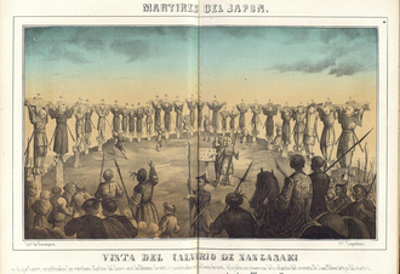
On October 19, 1596, the Spanish ship San Felipe was shipwrecked on Urado in Kōchi on the Japanese island of Shikoku en route from Manila to Acapulco. The local daimyo Chōsokabe …
The Spanish ship San Felipe was shipwrecked on the Japanese island of Shikoku, and its cargo confiscated by the local…
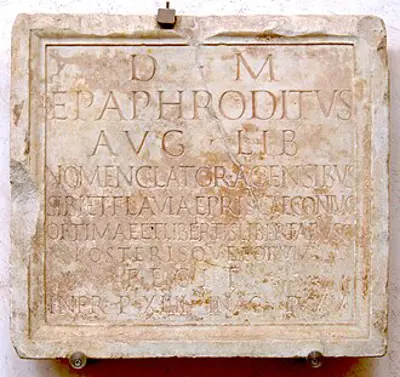
A nomenclator, in classical times, referred to a slave whose duty was to recall the names of persons his master met during a political campaign. Later, the scope was expanded to in…
Nomenclator of Leiden University Library appears, the first printed catalog of an institutional library
Saint Sava, known as the Enlightener or the Illuminator, was a Serbian prince and Orthodox monk who became the first Archbishop of the autocephalous Serbian Church. He was also a w…
The relics of Saint Sava are incinerated in Belgrade on the Vračar plateau by Ottoman Grand Vizier Sinan Pasha; the site
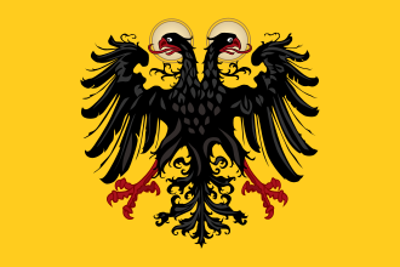
The Army of the Holy Roman Empire was created in 1422 and came to an end when the Holy Roman Empire was dissolved in 1806 as a result of the Napoleonic Wars.
An imperial army retakes the city of Esztergom from the Ottoman Empire.
Władysław IV Vasa or Ladislaus IV was King of Poland, Grand Duke of Lithuania and claimant of the thrones of Sweden and Russia. Born into the House of Vasa as a prince of Poland an…
Władysław IV Vasa, Polish king (died 1648)
Jan Marek Marci, also known as Johannes Marcus Marci was a Czech medical doctor and scientist. He was the rector of the University of Prague and official medical doctor to the Holy…
Jan Marek Marci, Czech medical doctor and scientist (died 1667)
Guru Hargobind was the sixth of ten Gurus of the Sikh religion. He became Guru at the age of eleven, after the execution of his father, Guru Arjan, by the Mughal emperor Jahangir.
Hargobind, sixth Sikh guru (died 1644)
Philipp Wolfgang was a count of Hanau-Lichtenberg. He ruled the county from 1625 until his death.
Philipp Wolfgang, Count of Hanau-Lichtenberg (died 1641)
The Battle of Clontibret was fought in County Monaghan in May 1595, during the Nine Years' War in Ireland. A column of 1,750 English troops led by Henry Bagenal was ambushed near C…
A Gaelic Irish army successfully ambushes an English force in the battle of Clontibret during the Nine Years' War
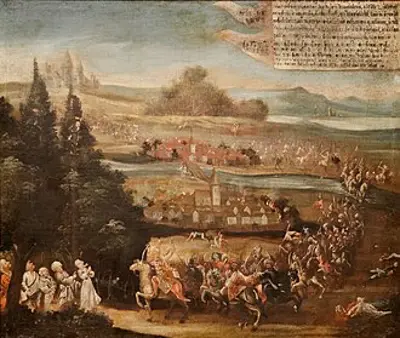
The Long Turkish War, or Thirteen Years' War, was an indecisive land war between the Holy Roman Empire and the Ottoman Empire, primarily over the principalities of Wallachia, Trans…
Long Turkish War: Wallachian prince Michael the Brave confronts the Ottoman army in the Battle of Călugăreni and…
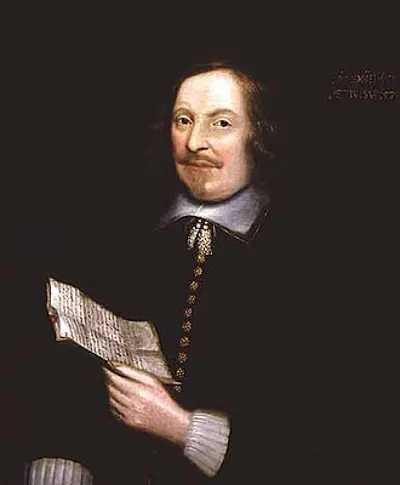
Edward Winslow was a Separatist and New England political leader who traveled on the Mayflower in 1620. He was one of several senior leaders on the ship and also later at Plymouth …
Edward Winslow, American Pilgrim leader (died 1655)

Torquato Tasso was an Italian poet of the 16th century, known for his 1581 poem Gerusalemme liberata, in which he depicts a highly imaginative version of the combats between Christ…
Torquato Tasso, Italian poet and songwriter (born 1544)
Valens Acidalius, also known as Valtin Havekenthal, was a German critic and poet writing in the Latin language.
Valens Acidalius, German poet and critic (born 1567)
Thomas Digges was an English mathematician and astronomer. He was the first to expound the Copernican system in English but discarded the notion of a fixed shell of immoveable star…
Thomas Digges, English mathematician and astronomer (born 1546)
António, Prior of Crato, sometimes called "The Determined", "The Fighter", "The Independentist" or "The Resistant", was a grandson of King Manuel I of Portugal who claimed the Port…
António, Prior of Crato (born 1531)
Baillie John MacMorran (1553-1595), a merchant and Baillie of Edinburgh, was killed during a riot at Edinburgh High School. His house at Riddle's Court is a valued monument on Edin…
John MacMorran, Baillie of Edinburgh, shot by rioting high school schoolchildren.
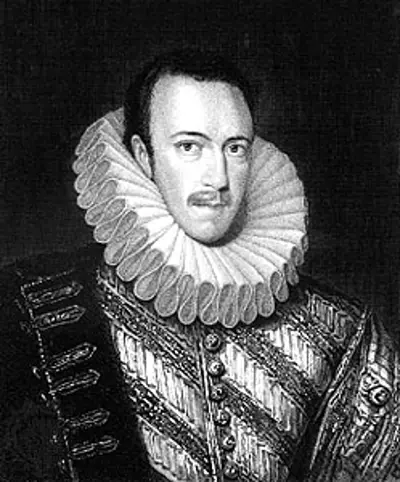
Philip Howard, 13th Earl of Arundel was an English nobleman. He was canonised by Pope Paul VI in 1970, as one of the Forty Martyrs of England and Wales. Howard lived mainly during …
Philip Howard, 20th Earl of Arundel, English nobleman (born 1537)
Coevorden is a municipality and city in the province of Drenthe, in the northeast of the Netherlands. It shares a provincial border with Overijssel and an international one with Ge…
The Dutch city of Coevorden, held by the Spanish, falls to a Dutch and English force
James VI and I was King of Scotland as James VI from 24 July 1567, and King of England and Ireland as James I from the union of the Scottish and English crowns on 24 March 1603, un…
King James VI of Scotland holds a masque at the baptism of Prince Henry at Stirling Castle.
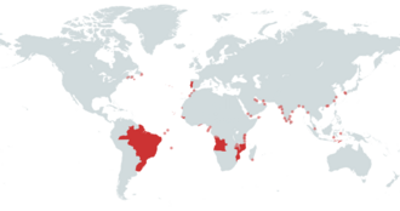
The Portuguese Empire was the first and longest lasting of the European colonial empires. Initiated during the Age of Discovery, at one point territories included parts of the Amer…
Troops of the Portuguese Empire are defeated on Sri Lanka, bringing an end to the Campaign of Danture.
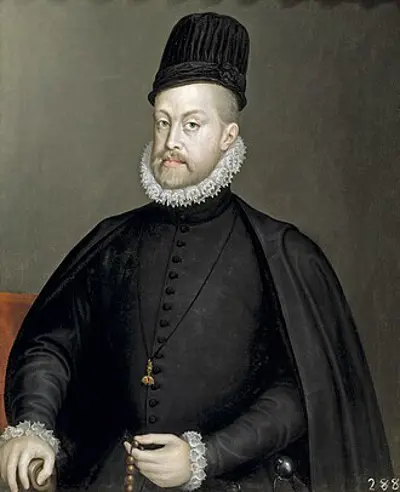
Philip II, sometimes known in Spain as Philip the Prudent, was King of Spain from 1556, King of Portugal from 1580, and King of Naples and Sicily from 1554 until his death in 1598.…
Philip II recognizes the rights and privileges of the local nobles and chieftains in the Philippines, which paved way to
The Action of Faial or the Battle of Faial Island was a naval engagement that took place on 22–23 June 1594 during the Anglo-Spanish War in which the large and richly laden 2,000-t…
The Action of Faial, Azores
The Portuguese Empire, c. 1415 to 1999, was the first and longest lasting of the European colonial empires. Initiated during the Age of Discovery, at one point territories included…
Portuguese forces under the command of Pedro Lopes de Sousa begin an unsuccessful invasion of the Kingdom of Kandy…