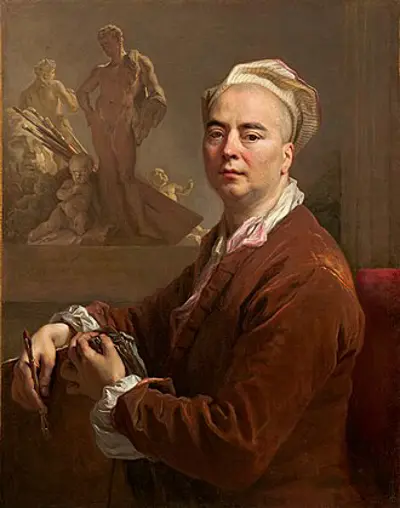
Guillaume Dubois, French cardinal and politician (died 1723)
Guillaume Dubois was a French cardinal and statesman.
Guillaume Dubois, French cardinal and politician (died 1723)
Explore 160 historical events from 1650β1659.
Guillaume Dubois was a French cardinal and statesman.
Guillaume Dubois, French cardinal and politician (died 1723)
Thomas Baker was an English antiquarian.
Thomas Baker, English historian and author (died 1746)
Thomas Fincke was a Danish mathematician and physicist, and a professor at the University of Copenhagen for more than 60 years.
Thomas Fincke, Danish mathematician and physicist (born 1561)
Jan Josephszoon van Goyen was a Dutch landscape painter. The scope of his landscape subjects was very broad as he painted forest landscapes, marine paintings, river landscapes, bea…
Jan van Goyen, Dutch painter and illustrator (born 1596)
Thomas Tomkins was a Welsh-born composer of the late Tudor and early Stuart period. In addition to being one of the prominent members of the English Madrigal School, he was a skill…
Thomas Tomkins, Welsh-English composer (born 1572)
François-Marie, comte de Broglie and comte de Revel was a prominent soldier and commander in the Thirty Years' War.
François-Marie, comte de Broglie, Italian-French general (born 1611)
Salomo Glassius was a German theologian and biblical critic born at Sondershausen, in the principality of Schwarzburg-Sondershausen.
Salomo Glassius, German theologian and critic (born 1593)
Ottavio Piccolomini, 1st Duke of Amalfi was an Italian nobleman whose military career included service as a Spanish general and then as a field marshal of the Holy Roman Empire.
Ottavio Piccolomini, Austrian-Italian field marshal (born 1599)
Joseph Hall was an English bishop, satirist and moralist. His contemporaries knew him as a devotional writer, and a high-profile controversialist of the early 1640s. In church poli…
Joseph Hall, English bishop (born 1574)
The Netherlands, also informally known as Holland, is a country in Northwestern Europe, with overseas territories in the Caribbean. It is the largest of the four constituent countr…
The Netherlands and the Ahanta people sign the Treaty of Butre, creating a Dutch protectorate over the country of…
An English expeditionary force captured Spanish Jamaica in May 1655, during the Anglo-Spanish War (1654–1660). It was part of an ambitious plan by Oliver Cromwell to undermine or o…
The Invasion of Jamaica begins during the Anglo-Spanish War
The Polish–Russian War of 1654–1667 was a major conflict between the Tsardom of Russia and the Polish–Lithuanian Commonwealth. Between 1655 and 1660, the Swedish invasion was also …
Russo-Polish War (1654–67): The Russian army enters the capital of the Grand Duchy of Lithuania, Vilnius, which it…
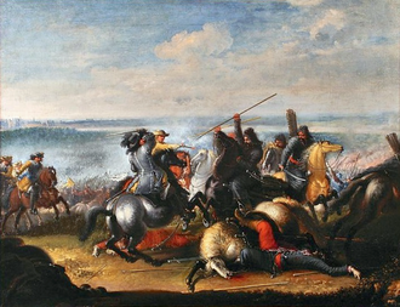
The Battle of Sobota took place near Sobota, Poland, on 23 August 1655, between the armies of the Polish–Lithuanian Commonwealth on the one hand and of Sweden on the other.
Battle of Sobota: The Swedish Empire led by Charles X Gustav defeats the Polish–Lithuanian Commonwealth.
The siege of Santo Domingo was fought between April 23, 1655 and April 30, 1655, at the Spanish Colony of Santo Domingo. A force of 2,400 Spanish troops led by Governor Don Bernard…
The Siege of Santo Domingo begins during the Anglo-Spanish War, and fails seven days later
Warsaw, officially the Capital City of Warsaw, is the capital and most populous city of Poland. The metropolis stands on the river Vistula in east-central Poland. Its population is…
Warsaw falls without resistance to a small force under the command of Charles X Gustav of Sweden during The Deluge,…
George St Lo was a British naval officer and politician.
George St Lo(e), Royal Navy officer and administrator (died 1718)
Bartolomeo Cristofori di Francesco was an Italian maker of musical instruments famous for inventing the piano.
Bartolomeo Cristofori, Italian instrument maker, invented the piano (died 1731)
Antonio Cifrondi was an Italian painter of the late Baroque, mainly of genre themes. He was active in Brescia and near Bergamo.
Antonio Cifrondi, Italian painter (died 1730)
Caspar Bartholin the Younger, was a Danish anatomist who first described the "Bartholin's gland" in the 17th century. The discovery of the Bartholin's gland is sometimes mistakenly…
Caspar Bartholin the Younger, Danish anatomist (died 1738)
Eustache Le Sueur or Lesueur was a French artist and one of the founders of the French Academy of Painting. He is known primarily for his paintings of religious subjects. He was a …
Eustache Le Sueur, French painter (born 1617)
Eleonora Gonzaga, was born a princess of Mantua as a member of the House of Gonzaga, and by marriage to Ferdinand II, Holy Roman Emperor, was Holy Roman Empress, German Queen, Quee…
Eleonora Gonzaga, Holy Roman Empress (born 1598)
Girolamo Rainaldi was an Italian architect who worked mainly in a conservative Mannerist style, often with collaborating architects. He was a successful competitor of Bernini. His …
Girolamo Rainaldi, Italian architect (born 1570)
Savinien de Cyrano de Bergerac was a French novelist, playwright, epistolarian, and duelist.
Cyrano de Bergerac, French poet and playwright (born 1619)
Alfonso de la Cueva-Benavides y Mendoza-Carrillo, marqués de Bedmar was a Spanish diplomat, bishop and Roman Catholic cardinal. He was born in Bedmar, in what is now the province …
Alfonso de la Cueva, 1st Marquis of Bedmar, Spanish cardinal and diplomat (born 1572)