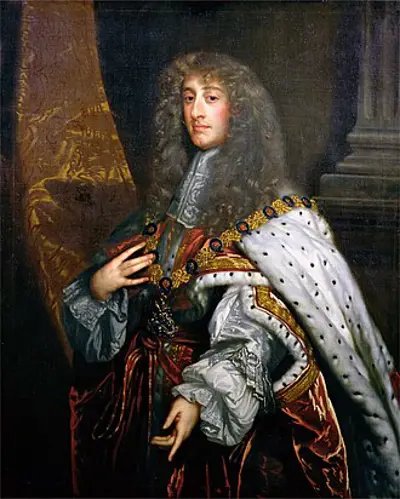
Mary II of England (died 1694)
Mary II was Queen of England, Scotland, and Ireland with her husband, King William III and II, from 1689 until her death in 1694. She was also Princess of Orange following her marr…
Mary II of England (died 1694)
Explore 111 historical events from 1660β1669.
Mary II was Queen of England, Scotland, and Ireland with her husband, King William III and II, from 1689 until her death in 1694. She was also Princess of Orange following her marr…
Mary II of England (died 1694)
Matthäus Daniel Pöppelmann (1662–1736) was a German master builder and architect who helped to rebuild Dresden after the fire of 1685. His most famous work is the Zwinger Palace.
Matthäus Daniel Pöppelmann, German architect, designed the Pillnitz Castle (died 1736)
George Smalridge was Bishop of Bristol (1714–1719).
George Smalridge, English bishop (died 1719)
Tokugawa Ienobu was a Japanese samurai, daimyo and the sixth shōgun of the Tokugawa dynasty of Japan. He was the eldest son of Tokugawa Tsunashige, thus making him the nephew of T…
Tokugawa Ienobu, Japanese shōgun (died 1712)
Maximilian II, also known as Max Emanuel or Maximilian Emanuel, was a Wittelsbach ruler of Bavaria and a prince-elector of the Holy Roman Empire. He was also the last governor of t…
Maximilian II Emanuel, Elector of Bavaria (died 1726)
Punch and Judy is a traditional English puppet show featuring Mr Punch and his wife Judy. The performance consists of a sequence of short scenes, each depicting an interaction betw…
The figure who later became Mr
John Gauden was an English cleric. He was Bishop of Exeter then Bishop of Worcester. He was also a writer, and the reputed author of the important Royalist work Eikon Basilike.
John Gauden, English bishop (born 1605)
The Yongli Emperor (1623–1662), personal name Zhu Youlang, was the fourth and last emperor of the Southern Ming dynasty, reigning in turbulent times when the former Ming dynasty wa…
Zhu Youlang, Chinese emperor (born 1623)
Sir Henry Vane, often referred to as Harry Vane and Henry Vane the Younger to distinguish him from his father, was an English politician and colonial administrator. He was briefly …
Henry Vane the Younger, English-American politician, Governor of the Massachusetts Bay Colony (born 1613)
Charles II was King of Scotland from 1649 until 1651 and King of England, Scotland, and Ireland from the 1660 Restoration of the monarchy until his death in 1685.
King Charles II of England, Scotland and Ireland is crowned in Westminster Abbey
A banknote or bank note – also called a bill or simply a note – is a type of paper money that is made and distributed ("issued") by a bank of issue, payable to the bearer on demand…
The first banknotes in Europe are issued by the Swedish bank Stockholms Banco.
Issachar Berend Lehmann, Berend Lehmann, Yissakhar Bermann Segal, Yissakhar ben Yehuda haLevi, or Berman Halberstadt, was a German banker, merchant, diplomatic agent as well as arm…
Issachar Berend Lehmann, German-Jewish banker, merchant and diplomat (died 1730)
Claude Buffier, French philosopher, historian and teacher, was born in Poland of French parents, who returned to France and settled in Rouen, then in the Province of Normandy, soon…
Claude Buffier, Polish-French historian and philosopher (died 1737)
Feodor III or Fyodor III Alekseyevich was Tsar of all Russia from 1676 until his death in 1682. Despite poor health from childhood, he managed to pass reforms on improving meritocr…
Feodor III of Russia (died 1682)
Charles Montagu, 1st Earl of Halifax was a British politician and poet. He was the grandson of the 1st Earl of Manchester and was eventually ennobled himself, first as Baron Halifa…
Charles Montagu, 1st Earl of Halifax, English poet and politician, First Lord of the Treasury (died 1715)
Hachisuka Tsunanori was a Japanese daimyō of the Edo period, who ruled the Tokushima Domain. His court title was Awaji no kami.
Hachisuka Tsunanori, Japanese daimyō (died 1730)
Pierre Le Moyne d'Iberville or Sieur d'Iberville was a French military officer, explorer, colonial administrator and merchant. He is noted for founding the colony of Louisiana in N…
Pierre Le Moyne d'Iberville, Canadian captain, explorer, and politician (died 1706)
Archibald Campbell, 1st Marquess of Argyll was a Scottish nobleman, politician, and peer. The de facto head of Scotland's government during most of the conflict of the 1640s and 16…
Archibald Campbell, 1st Marquess of Argyll, Scottish general and politician (born 1607)
Martino Martini was a Jesuit missionary in China. Born and raised in Trento, he worked as a cartographer and historian of ancient imperial China.
Martino Martini, Italian Jesuit missionary (born 1614)
Sir Henry Carey, 2nd Earl of Monmouth, KB was an English nobleman and translator.
Henry Carey, 2nd Earl of Monmouth, English politician (born 1595)
Andrea Sacchi was an Italian painter of High Baroque Classicism, active in Rome. A generation of artists who shared his style of art include the painters Nicolas Poussin and Giovan…
Andrea Sacchi, Italian painter (born 1599)
Sir Hugh Speke, 1st Baronet was an English politician who sat in the House of Commons in 1661.
Sir Hugh Speke, 1st Baronet
Charles II was King of Scotland from 1649 until 1651 and King of England, Scotland, and Ireland from the 1660 Restoration of the monarchy until his death in 1685.
Charles II was crowned King of England, Scotland and Ireland at Westminster Abbey
The Treaty or Peace of Oliva was one of the peace treaties ending the Second Northern War (1655–1660). It was signed on 3 May [O.S. 23 April] 1660. The Treaty of Oliva, the Treaty …
Treaty of Oliva is established between Sweden and Poland