J
Johann Sebastian Bach was a German composer and musician of the late Baroque period. He is known for his prolific output across a variety of instruments and forms, including the or…
J
Explore 194 historical events from 1710β1719.
Johann Sebastian Bach was a German composer and musician of the late Baroque period. He is known for his prolific output across a variety of instruments and forms, including the or…
J
The Electorate of Hanover was an electorate of the Holy Roman Empire located in northwestern Germany that arose from the Principality of Calenberg. Although formally known as the E…
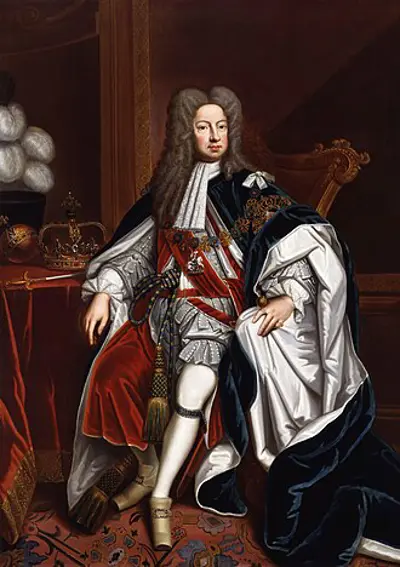
George Louis, Elector of Hanover, became King George I of Great Britain, marking the beginning of the Georgian era.
Charles VI was Holy Roman Emperor and ruler of the Austrian Habsburg monarchy from 1711 until his death, succeeding his elder brother, Joseph I. He unsuccessfully claimed the thron…
With no living male heirs, Charles VI, Holy Roman Emperor, issues the Pragmatic Sanction of 1713 to ensure that Habsburg
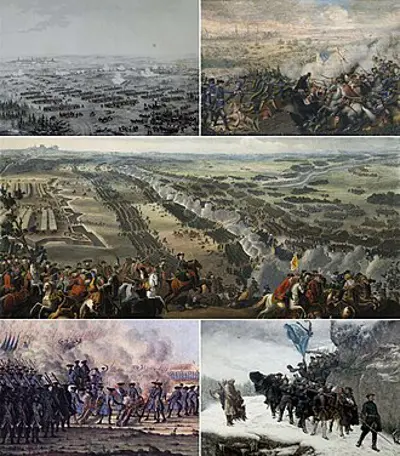
In the Great Northern War (1700–1721) a coalition led by Russia successfully contested the supremacy of Sweden in Northern, Central and Eastern Europe. The initial leaders of the a…
Great Northern War: After losing the Battle of Helsinki to the Russians, the Swedish and Finnish troops burn the entire
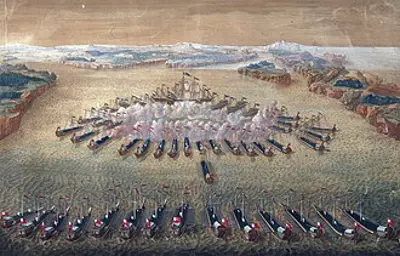
In the Great Northern War (1700–1721) a coalition led by Russia successfully contested the supremacy of Sweden in Northern, Central and Eastern Europe. The initial leaders of the a…
Great Northern War: The Russian Navy led by Admiral Fyodor Apraksin land both at Katajanokka and Hietalahti during the B
The Treaty of Adrianople, also called the Treaty of Edirne, was signed on 24 June 1713 between the Ottoman Empire and the Tsardom of Russia and confirmed the Treaty of the Pruth of…
The treaty of Adrianople ends the Russo-Ottoman War of 1711–1713, which restores territory to the Ottomans while allowin
Louis de Noailles, 4th Duke of Noailles was a French peer and Marshal of France.
Louis de Noailles, French general (died 1793)
Charles Batteux was a French philosopher and writer on aesthetics.
Charles Batteux, French philosopher and academic (died 1780)
Princess Caroline of Great Britain was the fourth child and third daughter of King George II of Great Britain and his wife Caroline of Ansbach.
Princess Caroline of Great Britain (died 1757)
Meshech Weare was an American farmer, lawyer, and statesman from Seabrook and Hampton Falls, New Hampshire. He served as the first president of New Hampshire. Before 1784 the posit…
Meshech Weare, American farmer, lawyer, and politician, 1st Governor of New Hampshire (died 1786)
Acadia was a colony of New France in northeastern North America which included parts of what are now the Maritime provinces, the Gaspé Peninsula and Maine to the Kennebec River. Se…
The French residents of Acadia are given one year to declare allegiance to Britain or leave Nova Scotia, Canada
Alexis Claude Clairaut was a French mathematician, astronomer, and physicist. He was a prominent Newtonian whose work helped to establish the validity of the principles and results…
Alexis Clairaut, French mathematician, astronomer, and geophysicist (died 1765)
John Stuart, 3rd Earl of Bute, styled Lord Mount Stuart between 1713 and 1723, was a British Tory statesman who served as the Prime Minister of Great Britain from 1762 to 1763 unde…
John Stuart, 3rd Earl of Bute, Scottish politician, Prime Minister of Great Britain (died 1792)
Lord John Philip Sackville was the second son of Lionel Sackville, 1st Duke of Dorset. He was a keen cricketer who was closely connected with the sport in Kent.
John Sackville, English cricketer and politician (died 1765)
Jacques-Germain Soufflot was a French architect in the international circle that introduced neoclassicism. His most famous works are the Panthéon in Paris, built from 1755 onwards,…
Jacques-Germain Soufflot, French architect, designed the Panthéon (died 1780)
Luís António Verney was a Portuguese philosopher, theologian, and pedagogue. An estrangeirado, Verney is sometimes called the most important figure of the Portuguese Enlightenment.
Luís António Verney, Portuguese philosopher and pedagogue (died 1792)
Charles, Duke of Brunswick-Lüneburg, reigned as Prince of Brunswick-Wolfenbüttel from 1735 until his death.
Charles I, German duke and prince (died 1780)
Johann Kies was a German astronomer and mathematician. Born in Tübingen, Kies worked in Berlin in 1751 alongside Jérôme Lalande in order to make observations on the lunar parallax …
Johann Kies, German astronomer and mathematician (died 1781)
David Hollatz was a German Lutheran theologian.
David Hollatz, Polish pastor and theologian (born 1648)
Thomas Sprat, FRS was an English churchman and writer, Bishop of Rochester from 1684.
Thomas Sprat, English bishop (born 1635)
Henry Compton was an Anglican clergyman who served as the Bishop of London from 1675 to 1713.
Henry Compton, English bishop (born 1632)
Count Johann Hartwig Ernst von Bernstorff was a German-Danish statesman and a member of the Bernstorff noble family of Mecklenburg. He was the son of Joachim Engelke Freiherr von B…
Count Johann Hartwig Ernst von Bernstorff, Danish politician and diplomat (died 1772)
Benjamin Ingham was an English cleric who was the founder of the Moravian Church in England as well as his own Inghamite societies.
Benjamin Ingham, American missionary (died 1772)
Luc Urbain du Bouëxic, comte de Guichen was a French Navy officer who commanded the fleets that fought the Royal Navy at the Battle of Ushant and Battle of Martinique during the Am…
Luc Urbain de Bouëxic, comte de Guichen, French admiral (died 1790)