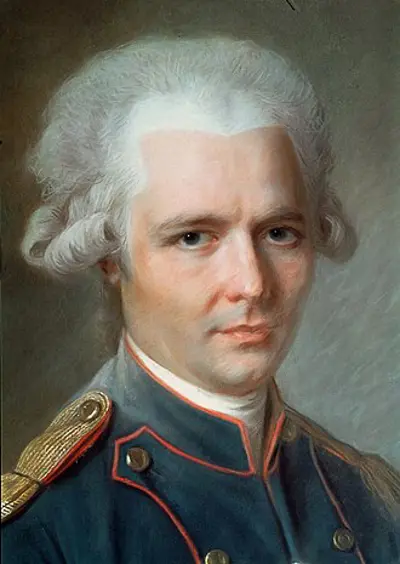
Samuel Arnold, English organist and composer (died 1802)
Samuel Arnold was an English composer and organist.
Samuel Arnold, English organist and composer (died 1802)
Explore 184 historical events from 1740β1749.
Samuel Arnold was an English composer and organist.
Samuel Arnold, English organist and composer (died 1802)
Matthias Claudius was a German poet and journalist, otherwise known by the pen name of "Asmus".
Matthias Claudius, German poet and author (died 1815)
Jean Baptiste Camille de Canclaux was a French army commander during the French Revolution and a Peer of France. He joined a cavalry regiment the French Royal Army in 1756 and foug…
Jean Baptiste Camille Canclaux, French general (died 1817)
The Montgolfier brothers – Joseph-Michel Montgolfier and Jacques-Étienne Montgolfier – were aviation pioneers, balloonists and paper manufacturers from the commune Annonay in Ardèc…
Joseph-Michel Montgolfier, French inventor, invented the hot air balloon (died 1810)
John Lynch was an American merchant and abolitionist who founded the city of Lynchburg, Virginia.
John Lynch, American city founder and abolitionist (died 1820)
Johan Tobias Sergel was a Swedish neoclassical sculptor. Sergels torg, the largest square in the centre of Stockholm and near where his workshop stood, is named after him.
Johan Tobias Sergel, Swedish sculptor and illustrator (died 1814)
Johann Heinrich Jung, better known by his assumed name Heinrich Stilling, was a German author. He is often called by both surnames as "Jung-Stilling".
Johann Heinrich Jung, German author and academic (died 1817)
Thomas Tickell was a minor English poet and man of letters.
Thomas Tickell, English poet and author (born 1685)
Ephraim Chambers was an English writer and encyclopaedist, who is primarily known for producing the Cyclopaedia, or an Universal Dictionary of Arts and Sciences. Chambers' Cyclopæd…
Ephraim Chambers, English publisher (born 1680)
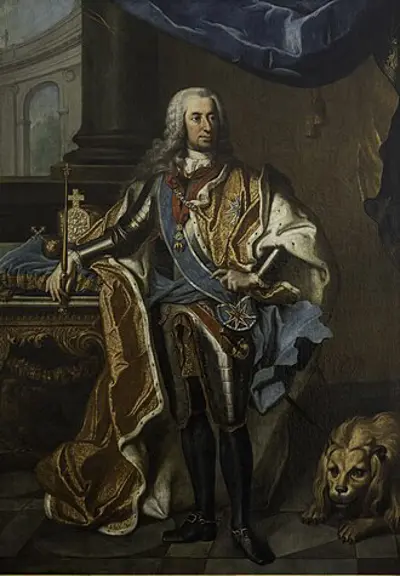
Frederick William I, known as the Soldier King, was King in Prussia and Elector of Brandenburg from 1713 until his death in 1740, as well as Prince of Neuchâtel.
Frederick William I of Prussia (born 1688)
Samuel Werenfels was a Swiss theologian. He was a major figure in the move towards a "reasonable orthodoxy" in Swiss Reformed theology.
Samuel Werenfels, Swiss theologian (born 1657)
Henry Grey, 1st Duke of Kent, was a British politician and courtier. None of his sons outlived him, so his new title became extinct on his death. Though the house he built at Wrest…
Henry Grey, 1st Duke of Kent, English politician and courtier (born 1671)
Francis Scobell was an English politician affiliated with the Tories. He was a member of parliament (MP) for Mitchell from 1690 to 1695, Grampound from 16 January 1699 to 1708, S…
Francis Scobell, English politician (born 1664)
Major-General Alexander Spotswood was a British army officer, explorer and colonial administrator who served as the governor of Virginia from 1710 to 1722. After an unsatisfactory …
Alexander Spotswood, Moroccan-American colonial and politician, Lieutenant Governor of Virginia (born 1676)
Sir William Wyndham, 3rd Baronet was a British Tory politician who sat in the House of Commons of Great Britain from 1710 to 1740. He served as Secretary at War in 1712 and Chancel…
Sir William Wyndham, 3rd Baronet, English politician, Chancellor of the Exchequer (born 1687)
The War of Jenkins' Ear was fought between Great Britain and Spain from 1739 to 1748. Most of the fighting took place in New Granada and the Caribbean Sea, with major operations ov…
War of Jenkins' Ear: Spanish troops stormed the British-held strategically crucial position of Fort Mose in Spanish Flor