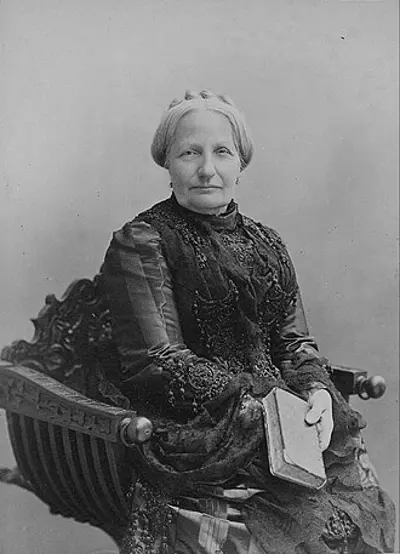
Samuel Morey, American engineer (born 1762)
Samuel Morey was an American inventor, who worked on early internal combustion engines and was a pioneer in steamships who accumulated a total of 20 patents.
Samuel Morey, American engineer (born 1762)
Explore 629 historical events from 1840β1849.
Samuel Morey was an American inventor, who worked on early internal combustion engines and was a pioneer in steamships who accumulated a total of 20 patents.
Samuel Morey, American engineer (born 1762)
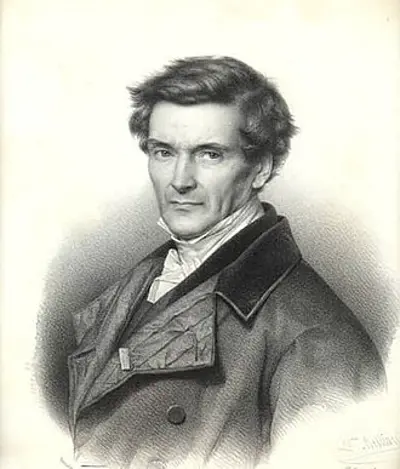
Sylvestre François Lacroix was a French mathematician.
Sylvestre François Lacroix, French mathematician and academic (born 1765)
Noah Webster was an American lexicographer, textbook pioneer, English-language spelling reformer, political writer, editor, and author. He has been called the "Father of American S…
Noah Webster, American lexicographer (born 1758)
Christian Friedrich Samuel Hahnemann was a German medical doctor, best known for creating the pseudoscientific system of alternative medicine called homeopathy.
Samuel Hahnemann, German physician and academic (born 1755)
Charles Macintosh FRS was a Scottish chemist and the inventor of the modern waterproof raincoat. The Mackintosh raincoat is named after him.
Charles Macintosh, Scottish chemist and inventor of waterproof fabric (born 1766)
Joseph Nicolas Nicollet, also known as Jean-Nicolas Nicollet, was a French geographer, astronomer, and mathematician known for mapping the Upper Mississippi River basin during the …
Joseph Nicollet, French mathematician and explorer (born 1786)
Johann Christian Friedrich Hölderlin was a German poet and philosopher. Described by Norbert von Hellingrath as "the most German of Germans", Hölderlin was a key figure of German R…
Friedrich Hölderlin, German lyric poet and author (born 1770)
Ezekiel Hart was an entrepreneur and politician in British North America. He is often said to be the first Jew to be elected to public office in the British Empire.
Ezekiel Hart, Canadian businessman and politician (born 1770)
Gaspard-Gustave de Coriolis was a French mathematician, mechanical engineer and scientist. He is best known for his work on the supplementary forces that are detected in a rotating…
Gaspard-Gustave de Coriolis, French mathematician, physicist, and engineer (born 1792)
SS Great Britain is a museum ship and former passenger steamship that was advanced for her time. The largest passenger ship in the world from 1845 to 1853, she was designed by Isam…
SS Great Britain, the first ocean-going ship with both an iron hull and a screw propeller, was launched (pictured) in…
Dona Teresa Cristina, popularly known as "the Mother of the Brazilians", was Empress of Brazil as the wife of Emperor Dom Pedro II, a position she held from her marriage in 1843 un…
The state wedding of Teresa Cristina of the Two Sicilies and Emperor Pedro II of Brazil took place at the Cathedral of…
A wagon train is a group of wagons traveling together. Before the extensive use of military vehicles, baggage trains followed an army with supplies and ammunition.
The first major wagon train heading for the Pacific Northwest sets out on the Oregon Trail from Elm Grove, Missouri, wit
The Lombard Street riot was a racially motivated mob attack on the free Black community in Philadelphia, Pennsylvania, on August 1, 1842.
The Lombard Street riot erupts in Philadelphia, Pennsylvania, United States.
The Treaty of Nanjing was the peace treaty which ended the First Opium War (1839–1842) between Great Britain and the Qing dynasty of China on 29 August 1842. It was the second of w…
Treaty of Nanking signing ends the First Opium War.
On 8 May 1842, a train crashed in the cutting between Meudon and Bellevue stations on the railway between Versailles and Paris, France. The train was travelling to Paris when it de…
A train derails and catches fire in Paris, killing between 52 and 200 people
The Illustrated London News, founded by Herbert Ingram and first published on Saturday 14 May 1842, was the world's first illustrated weekly news magazine. The magazine was publish…
The first edition of The Illustrated London News, the world's first illustrated weekly news magazine, was published
Victoria was Queen of the United Kingdom of Great Britain and Ireland from 20 June 1837 until her death in 1901. Her reign of 63 years and 216 days, which was longer than those of …
John Francis attempts to murder Queen Victoria as she drives down Constitution Hill in London with Prince Albert
The Webster–Ashburton Treaty was a treaty that resolved several border issues between the United States and the British North American colonies. Negotiated in the US federal capita…
The Webster–Ashburton Treaty is signed, establishing the United States–Canada border east of the Rocky Mountains.
Maurice Rouvier was a French statesman of the "Opportunist" faction, who twice served as the Prime Minister of France. He is best known for his financial policies and his unpopular…
Maurice Rouvier, French businessman and politician, 53rd Prime Minister of France (died 1911)
Carl Joseph Millöcker, was an Austrian composer of operettas and a conductor.
Carl Millöcker, Austrian composer and conductor (died 1899)
Emil Christian Hansen was a Danish mycologist and fermentation physiologist.
Emil Christian Hansen, Danish physiologist and mycologist (died 1909)
Jules Émile Frédéric Massenet was a French composer of the Romantic era best known for his operas, of which he wrote more than thirty. The two most frequently staged are Manon (188…
Jules Massenet, French composer (died 1912)
Sir Arthur Seymour Sullivan was an English composer. He is best known for 14 comic opera collaborations with the dramatist W. S. Gilbert, including H.M.S. Pinafore, The Pirates of …
Arthur Sullivan, English composer (died 1900)
The American Indian Wars, also known as the American Frontier Wars, and the Indian Wars, were initially fought by European colonial empires, the United States, and briefly the Conf…
American Indian Wars: Second Seminole War ends, with the Seminoles forced from Florida.