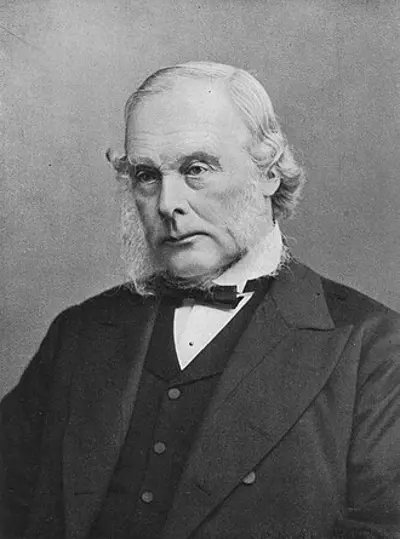
Konstantin Flavitsky, Russian painter (born 1830)
Konstantin Dmitriyevich Flavitsky was a Russian painter, best known for his history paintings, typical of late Romantic style.
Konstantin Flavitsky, Russian painter (born 1830)
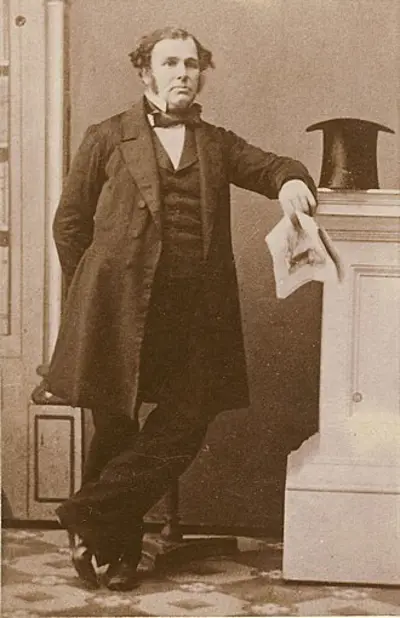
Explore 1232 historical events from 1860β1869.
Konstantin Dmitriyevich Flavitsky was a Russian painter, best known for his history paintings, typical of late Romantic style.
Konstantin Flavitsky, Russian painter (born 1830)
Per Gustaf Svinhufvud af Qvalstad was a Finnish provincial treasurer of Tavastia and the host of the Rapola Manor in Sääksmäki. His grandson was Pehr Evind Svinhufvud, the future t…
Per Gustaf Svinhufvud af Qvalstad, treasurer of Tavastia province, manor host, and paternal grandfather of President…
John Kinder Labatt was an Irish-Canadian brewer and the founder of the Labatt Brewing Company.
John Kinder Labatt, Irish-Canadian brewer, founded the Labatt Brewing Company (born 1803)
Max Bruch was a German Romantic composer, violinist, teacher, and conductor who wrote more than 200 works, including three violin concertos, the first of which has become a staple …
German composer Max Bruch (pictured) conducted the premiere of his first violin concerto, which later became his most fa
The Shield nickel was the first United States five-cent piece to be made out of copper-nickel, the same alloy of which American nickels are struck today. Designed by James B. Longa…
The United States Congress authorized the minting of the Shield nickel (example pictured), the country's first five-cent
Bedřich Smetana was a Czech composer who pioneered the development of a musical style that became closely identified with his people's aspirations to a cultural and political "revi…
Bedřich Smetana's comic opera The Bartered Bride (cover of score pictured) premiered in Prague
Lavinia Ellen "Vinnie" Ream Hoxie was an American sculptor. Her most famous work is the statue of U.S. President Abraham Lincoln in the United States Capitol rotunda. Ream's Statue…
Aged 18, Vinnie Ream became the youngest artist and first woman to receive a United States government commission for a…
The Army of the Potomac was the primary field army of the Union army in the Eastern Theater of the American Civil War. It was created in July 1861 shortly after the First Battle of…
The Army of the Potomac is disbanded
The United States Secret Service is a federal law enforcement agency under the United States Department of Homeland Security. It is tasked with conducting criminal investigations a…
The United States Secret Service begins operation.
Y Wladfa, also occasionally Y Wladychfa Gymreig, refers to the establishment of settlements by Welsh colonists and immigrants in the Argentine Patagonia, beginning in 1865, mainly …
Welsh settlers arrive at Chubut in Argentina.
A narrow-gauge railway is a railway with a track gauge narrower than 1,435 mm standard gauge. Most narrow-gauge railways are between 600 mm and 1,067 mm.
The first narrow-gauge mainline railway in the world opens at Grandchester, Queensland, Australia.
Joseph Lister, 1st Baron Lister was an English surgeon, medical scientist, experimental pathologist and pioneer of antiseptic surgery and preventive healthcare. Lister revolutionis…
Joseph Lister, British surgeon and scientist, performs the first antiseptic surgery.
General Sir Henry George Chauvel, was a senior officer of the Australian Imperial Force who fought at Gallipoli and during the Sinai and Palestine Campaign in the Middle Eastern th…
Harry Chauvel, Australian general (died 1945)
Julia Ledóchowska, USAHJ, in religion Maria Ursula of Jesus, was a Polish Catholic religious sister who founded the Ursulines of the Agonizing Heart of Jesus.
Ursula Ledóchowska, Polish-Austrian nun and saint, founded the Congregation of the Ursulines of the Agonizing Heart of J
Ali Agha Ismail Agha oghlu Shikhlinski ; 3 March [O.S. 15 March] 1863 – 18 August 1943) was an Azerbaijani lieutenant-general of the Imperial Russian Army, Deputy Minister of Defen…
Ali-Agha Shikhlinski, Russian-Azerbaijani general (died 1943)
Akseli Gallen-Kallela was a Finnish painter who is best known for his illustrations of the Kalevala, the Finnish national epic. His work is considered a very important aspect of th…
Akseli Gallen-Kallela, Finnish artist (died 1931)
Max Heinrich Hermann Reinhardt Nettlau was a German anarchist and historian.
Max Nettlau, German historian and academic (died 1944)
William Clyde Fitch was an American dramatist, the most popular writer for the Broadway stage of his time.
Clyde Fitch, American playwright (died 1909)
Helen Maud Merrill was an American litterateur and poet from Maine. Her first published poem was in the Waterville Sentinel, in 1882. During the decade of 1882–1892, Merrill contri…
Helen Maud Merrill, American litterateur and poet (died 1943)
Angelo Secchi was an Italian Catholic priest and astronomer from the Italian region of Emilia. He was director of the observatory at the Pontifical Gregorian University for 28 year…
Astronomer Angelo Secchi demonstrates the Secchi disk, which measures water clarity, aboard Pope Pius IX's yacht, the L'
The Union is a term used to refer to the central government and loyal states of the United States during the American Civil War. Its military forces and civilian population resiste…
Union cavalry troopers corner and shoot dead John Wilkes Booth, assassin of President Abraham Lincoln, in Virginia
The Empire of Brazil was a 19th-century state that broadly comprised the territories which form modern Brazil and Uruguay until the latter achieved independence in 1828. The empire…
The Empire of Brazil, Argentina, and Uruguay sign the Treaty of the Triple Alliance
The conclusion of the American Civil War commenced with the articles of surrender agreement of the Army of Northern Virginia on April 9, at Appomattox Court House, by General Rober…
American Civil War: The Confederate government was declared dissolved at Washington, Georgia
Epitácio Lindolfo da Silva Pessoa was a Brazilian politician and jurist who served as the 11th president of Brazil between 1919 and 1922, when Rodrigues Alves was unable to take of…
Epitácio Pessoa, Brazilian jurist and politician, 11th President of Brazil (died 1942)