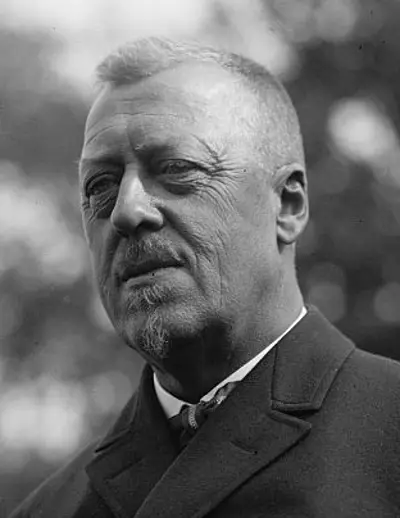
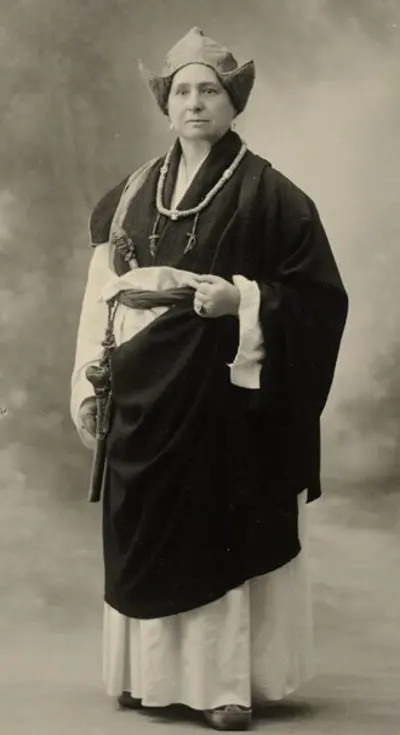
Alexander Rummler, American painter (died 1959)
Alexander Joseph Rummler was an American painter best known for his work on murals and billboards.
Alexander Rummler, American painter (died 1959)
Explore 683 historical events from 1860β1869.
Alexander Joseph Rummler was an American painter best known for his work on murals and billboards.
Alexander Rummler, American painter (died 1959)
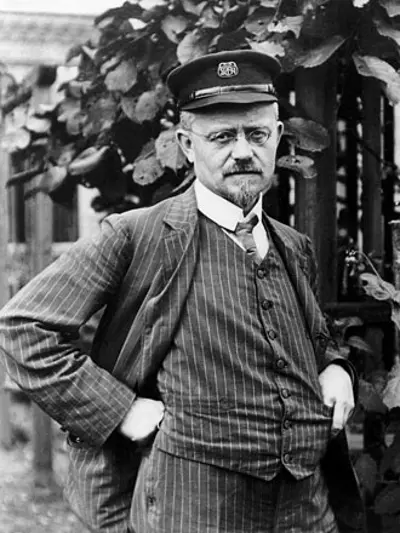
Enric Granados i Campiña, born Pantaleón Enrique Joaquín Granados Campiña was a Spanish and Catalan composer and pianist. Along with Isaac Albéniz, Joaquin Malats and other pianist…
Enrique Granados, Spanish pianist and composer (died 1916)
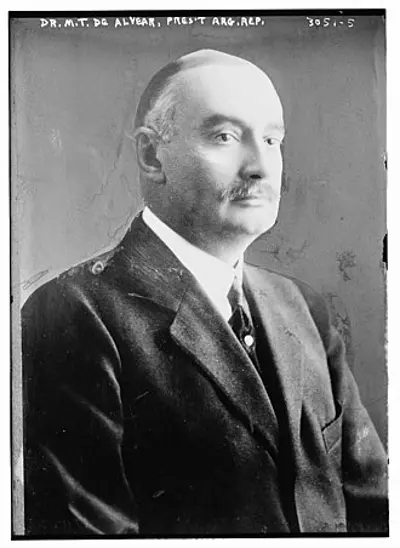
Charles Dillon Perrine was an American astronomer at the Lick Observatory in California (1893-1909) who moved to Cordoba, Argentina to accept the position of Director of the Argent…
Charles Dillon Perrine, American-Argentinian astronomer (died 1951)
Berthold Oppenheim (1867–1942) was the rabbi of Olomouc, Moravia, from 1892 to 1939. He was murdered in 1942 at the Treblinka extermination camp.
Berthold Oppenheim, Moravian rabbi (died 1942)
Friedrich Wilhelm Eduard Gerhard was a German archaeologist. He was co-founder and secretary of the first international archaeological society.
Friedrich Wilhelm Eduard Gerhard, German archaeologist and academic (born 1795)
Clarkson Frederick Stanfield was an English artist best known for his large-scale paintings of marine art and landscapes. A former sailor he became celebrated for his Romantic seas…
Clarkson Stanfield, English painter (born 1793)
Thomas Bulfinch was an American author born in Newton, Massachusetts, known best for Bulfinch's Mythology, a posthumous combination of his three volumes of mythologies.
Thomas Bulfinch American mythologist (born 1796)
Socrates Nelson was an American businessman, politician, and pioneer who served one term as a Minnesota State Senator from 1859 to 1861. He was a general store owner, lumberman, an…
Socrates Nelson, American businessman and politician (born 1814)
Ramón Castilla y Marquesado was a Peruvian caudillo who served twice as President of Peru, first in 1845–1851, and then in 1855–1862. He also led a Military junta in 1844, and was …
Ramón Castilla, Peruvian military leader and politician, President of Peru (born 1797)
Miguel Gregorio de la Luz Atenógenes Miramón y Tarelo, known as Miguel Miramón, was a Mexican conservative general who disputed the Mexican presidency with Benito Juárez at the age…
Miguel Miramón, Unconstitutional president of Mexico, 1859-1860 (born 1832)
Maximilian I was an Austrian archduke who became emperor of the Second Mexican Empire from 10 April 1864 until his execution by the Mexican Republic on 19 June 1867.
Maximilian I of Mexico (born 1832)
Otto was King of Greece from the establishment of the Kingdom of Greece on 7 May 1832, under the Convention of London, until he was deposed in October 1862.
Otto, king of Greece (born 1815)
The second French intervention in Mexico, also known as the Second Franco-Mexican War (1861–1867), was a military invasion of the Republic of Mexico by the French Empire of Napoleo…
Second French intervention in Mexico: Emperor Maximilian I of Mexico was executed by firing squad in Querétaro City
The United States Congress is the legislative branch of the federal government of the United States. It is a bicameral legislature, including a lower body, the U.S. House of Repres…
The United States Congress established the Indian Peace Commission to seek peace treaties with a number of Native…
Memorial Day is a federal holiday in the United States for mourning the U.S. military personnel who died while serving in the United States Armed Forces. It is observed on the last…
Memorial Day first celebrated in United States at Waterloo, New York
The United States Congress is the legislative branch of the federal government of the United States. It is a bicameral legislature, including a lower body, the U.S. House of Repres…
The United States Congress establishes the nickel
Oliver Fisher Winchester was an American businessman and politician, best known as being the founder of the Winchester Repeating Arms Company.
Oliver Winchester founded the Winchester Repeating Arms
The Battle of Custoza took place on the 24 June 1866 during the Third Italian War of Independence in the Italian unification process.
Battle of Custoza: An Austrian army defeats the Italian army during the Austro-Prussian War
Transatlantic telegraph cables are undersea cables running under the Atlantic Ocean which were used for telegraph communications.
The first permanent transatlantic telegraph cable is successfully completed, stretching from Valentia Island, Ireland,…
José de Diego y Martínez was a Puerto Rican statesman, journalist, poet, lawyer, and advocate for Puerto Rico's political autonomy in union with Spain and later of Puerto Rican ind…
José de Diego, Puerto Rican journalist, lawyer, and politician (died 1918)
The Memphis massacre of 1866 was a rebellion with a series of violent events that occurred from May 1 to 3, 1866, in Memphis, Tennessee. The racial violence was ignited by politica…
The Memphis Race Riots begin
Peruvians are the citizens of Peru. What is now Peru has been inhabited for several millennia by cultures such as the Caral before the Spanish conquest in the 16th century. Peruvia…
Peruvian defenders fight off the Spanish fleet at the Battle of Callao
Bedřich Smetana was a Czech composer who pioneered the development of a musical style that became closely identified with his people's aspirations to a cultural and political "revi…
Bedrich Smetana's comic opera The Bartered Bride premiered in Prague
Ernest Henry Starling was a British physiologist who contributed many fundamental ideas to this subject. These ideas were important parts of the British contribution to physiology,…
Ernest Starling, English physiologist and academic (died 1927)