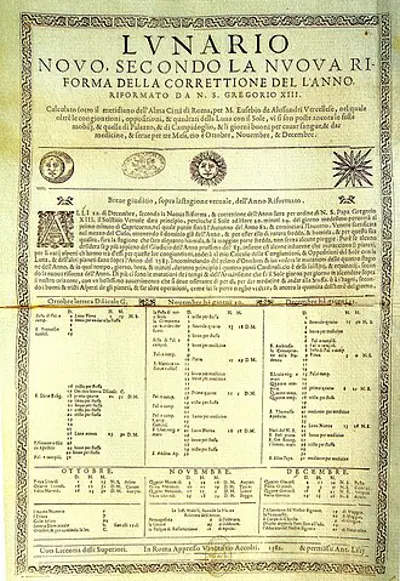
The adoption of the Gregorian Calendar has taken place in the history of most cultures and societies around the world, marking a change from one of various traditional dating systems to the contemporary system – the Gregorian Calendar – which is widely used around the world today. Some polities adopted the new calendar in 1582, others not before the early twentieth century, and others at various dates between. A few have yet to do so, but except for these, the Gregorian Calendar is now the universal civil calendar, yet old style calendars remain in use in religious or traditional contexts. During – and for some time after – the transition between systems, it has been common to use the terms "Old Style" and "New Style" in dating to indicate which calendar was used to reckon them.
Adoption of the Gregorian calendar begins, eventually leading to near-universal adoption.
On October 15, in the year 1582, Adoption of the Gregorian calendar begins, eventually leading to near-universal adoption. This event is recorded as a Historical Events event in the history of October 15, one of 403 recorded events on this date across all of history.
Key Facts
- This event took place on October 15, 1582 (AD era).
- It is categorised as a Historical Events event in recorded history.
- Referenced in 1 Wikipedia article.
- Wikipedia source last updated on 27 September 2026.
On This Date in History 403
This article draws on content from Wikipedia, available under CC BY-SA 4.0.
More on October 15
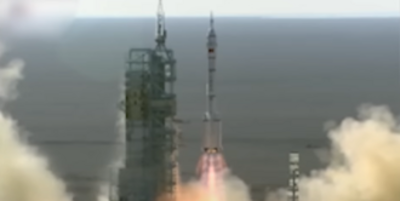
China launches Shenzhou 5, its first crewed space mission.
Shenzhou 5 was the first human spaceflight mission of the Chinese space program, launched on 15 October 2003. The Shenzhou spacecraft was launched on a Long March 2F launch vehicl…
China launches Shenzhou 5, its first crewed space mission.
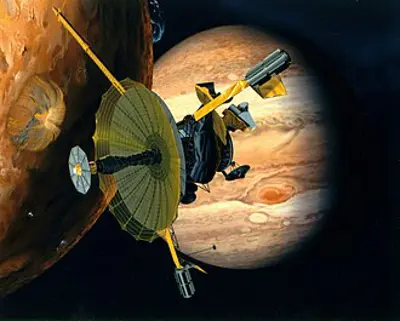
NASA's Galileo spacecraft passes within 112 miles (180 km) of Jupiter's moon Io.
Galileo was an American robotic space probe that studied the planet Jupiter and its moons, as well as the asteroids Gaspra and Ida. Named after the Italian astronomer Galileo Gali…
NASA's Galileo spacecraft passes within 112 miles (180 km) of Jupiter's moon Io.
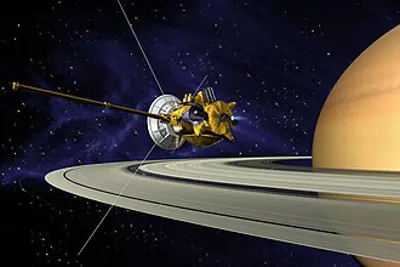
The Cassini probe launches from Cape Canaveral on its way to Saturn.
Cassini–Huygens, commonly called Cassini, was a joint space-research mission by NASA, the European Space Agency (ESA), and the Italian Space Agency (ASI) to send a space probe to …
The Cassini probe launches from Cape Canaveral on its way to Saturn.

The United States, under the Clinton administration, returns Haiti's first democratically elected president,…
Bill Clinton's tenure as the 42nd president of the United States began with his first inauguration on January 20, 1993, and ended on January 20, 2001. Clinton, a Democrat from Ark…
The United States, under the Clinton administration, returns Haiti's first democratically elected president,…
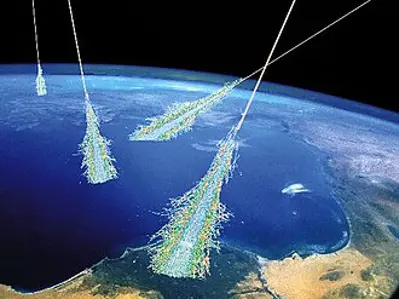
The "Oh-My-God particle", an ultra-high-energy cosmic ray measured at 40,000,000 times that of the highest energy…
The Oh-My-God particle (as physicists dubbed it) was an ultra-high-energy cosmic ray detected on 15 October 1991 by the Fly's Eye camera in Dugway Proving Ground, Utah, United Sta…
The "Oh-My-God particle", an ultra-high-energy cosmic ray measured at 40,000,000 times that of the highest energy…
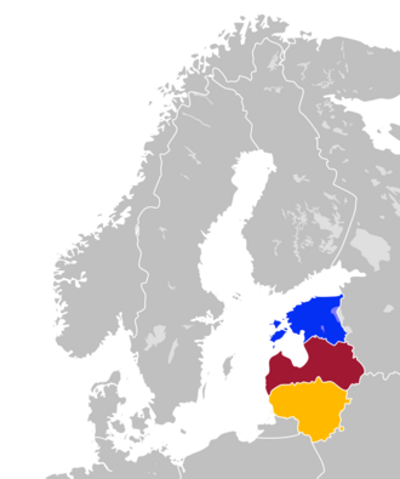
The leaders of the Baltic States, Arnold Rüütel of Estonia, Anatolijs Gorbunovs of Latvia and Vytautas Landsbergis of…
The Baltic states or the Baltic countries is a geopolitical term encompassing Estonia, Latvia, and Lithuania. All three countries are members of NATO, the European Union, the Euro…
The leaders of the Baltic States, Arnold Rüütel of Estonia, Anatolijs Gorbunovs of Latvia and Vytautas Landsbergis of…

Comments 0
Sign in to join the discussion.