
1876
The April Uprising begins
The April Uprising begins. Its suppression shocks European opinion, and Bulgarian independence becomes a condition for ending the Russo-Turkish War.
2966 results for “War of the First Coalition: Napoleon Bonaparte conquers Venice” — type: events (838 ms)
The April Uprising begins. Its suppression shocks European opinion, and Bulgarian independence becomes a condition for ending the Russo-Turkish War.

The Bandung Conference ends: Twenty-nine non-aligned nations of Asia and Africa finish a meeting that condemns colonialism, racism, and the Cold War.

The U.S. Department of Justice bars Austrian President Kurt Waldheim (and his wife, Elisabeth, who had also been a Nazi) from entering the US, charging that he had aided in the deportations and execut�
The Sino-Japanese Peace Treaty (Treaty of Taipei) is signed in Taipei, Taiwan between Japan and the Republic of China to officially end the Second Sino-Japanese War.
A week after being arrested by the Prussian Secret Police, French police inspector Guillaume Schnaebelé is released on order of William I, German Emperor, defusing a possible war.
A combined Spanish and Portuguese fleet of 52 ships commences the recapture of Bahia from the Dutch during the Dutch–Portuguese War.
The International Military Tribunal for the Far East convenes and indicts former Prime Minister of Japan Hideki Tojo and 28 former Japanese leaders for war crimes.
Theta Xi fraternity is founded at Rensselaer Polytechnic Institute, the only fraternity to be founded during the American Civil War.
U.S. media release graphic photos of American soldiers committing war crimes against Iraqi prisoners at Abu Ghraib prison.
Fall of Saigon: Communist forces gain control of Saigon. The Vietnam War formally ends with the unconditional surrender of South Vietnamese president Dương Văn Minh.
Twenty sailors are killed when the British Type 42 destroyer HMS Sheffield is hit by an Argentinian Exocet missile during the Falklands War.
The International Military Tribunal for the Far East begins in Tokyo with twenty-eight Japanese military and government officials accused of war crimes and crimes against humanity.
The East India Company disbands the 34th Regiment of Bengal Native Infantry whose sepoy Mangal Pandey had earlier revolted against the British in the lead up to the War of Indian Independence.
Edward George Honey proposes the idea of a moment of silence to commemorate the Armistice of 11 November 1918 which ended World War I.
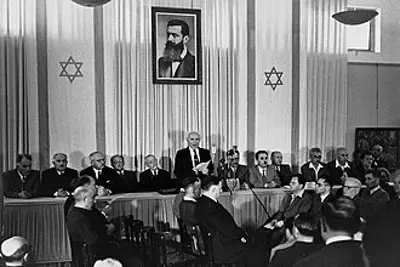
�ared to be an independent state and a provisional government is established. Immediately after the declaration, Israel is attacked by the neighboring Arab states, triggering the 1948 Arab–Israeli War.
Following the expiration of The British Mandate for Palestine, the Kingdom of Egypt, Transjordan, Lebanon, Syria, Iraq and Saudi Arabia invade Israel thus starting the 1948 Arab–Israeli War.
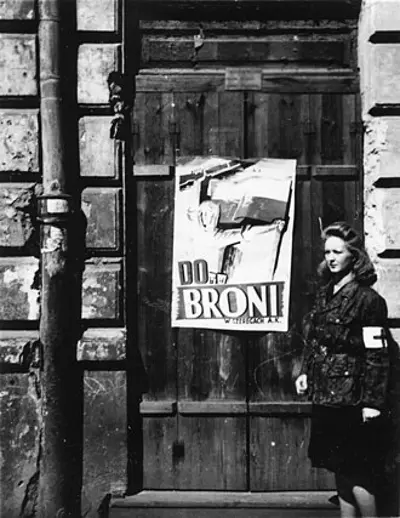
Insurgent peasants led by Anabaptist pastor Thomas Müntzer were defeated at the Battle of Frankenhausen, ending the German Peasants' War in the Holy Roman Empire.
The French government and representatives of the Provisional Government of the Algerian Republic reach a settlement to end the Algerian war in the Évian Accords.
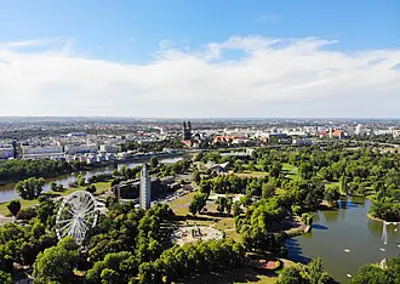
The city of Magdeburg in Germany is seized by forces of the Holy Roman Empire and most of its inhabitants massacred, in one of the bloodiest incidents of the Thirty Years' War.

The victory military parade by the Finnish White Guard is held in Helsinki celebrating their decisive victory in the Finnish Civil War. The day also begin to be celebrated on the Defence Forces Flag D�