John IV, Duke of Brittany (born 1295)
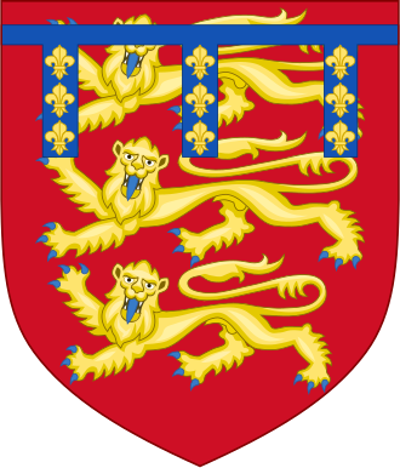
John IV the Conqueror KG, was Duke of Brittany and Count of Montfort from 1345 until his death and 7th Earl of Richmond from 1372 until his death.
John IV, Duke of Brittany (born 1295)
Explore 91 historical events from 1340β1349.
John IV the Conqueror KG, was Duke of Brittany and Count of Montfort from 1345 until his death and 7th Earl of Richmond from 1372 until his death.
John IV, Duke of Brittany (born 1295)
Alexios Apokaukos, also Latinized as Alexius Apocaucus, was a chief minister and head of the navy in the Byzantine Empire, during the reigns of emperors Andronikos III Palaiologos …
Alexios Apokaukos, chief minister of the Byzantine Empire
Andrew, Duke of Calabria was the first husband of Joanna I of Naples, and a son of Charles I of Hungary and brother of Louis I of Hungary.
Andrew, Duke of Calabria (born 1327)
Henry, 3rd Earl of Leicester and Lancaster was an English nobleman. He was the grandson of King Henry III of England and was one of the principals behind the deposition of King Edw…
Henry, 3rd Earl of Lancaster, English politician, Lord High Steward (born 1281)
William II was Count of Hainaut from 1337 until his death. He was also Count of Holland and Count of Zeeland. He succeeded his father, Count William I of Hainaut. While away fighti…
William II, Count of Hainaut
The megas doux was one of the highest positions in the hierarchy of the later Byzantine Empire, denoting the commander-in-chief of the Byzantine navy. It is sometimes also given in…
Inspecting a new prison without being escorted by his bodyguard, the megas doux Alexios Apokaukos, chief minister of the
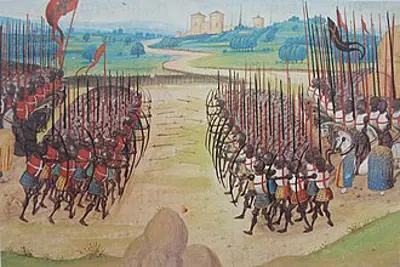
The Hundred Years' War was a series of conflicts between the kingdoms of England and France and a civil war in France during the late Middle Ages. It emerged from feudal disputes o…
Hundred Years' War: The English victory at the Battle of Auberoche marked a change in the military balance of power in…
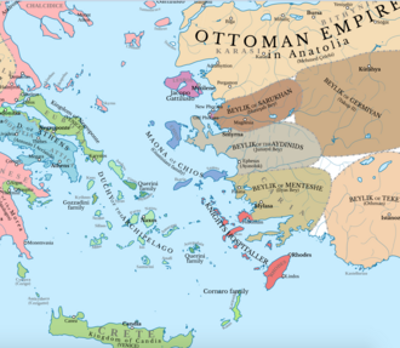
The Aydinids or Aydinid dynasty, also known as the Principality of Aydin and Beylik of Aydin, was one of the Turkoman Anatolian beyliks and famous for its seaborne raiding.
The lower town of Smyrna is captured by Latin Christians in response to Aydınid piracy during the Smyrniote crusades.
Marie of France was the sixth child and second daughter of John II of France and Bonne of Bohemia.
Marie of France, Duchess of Bar (died 1404)
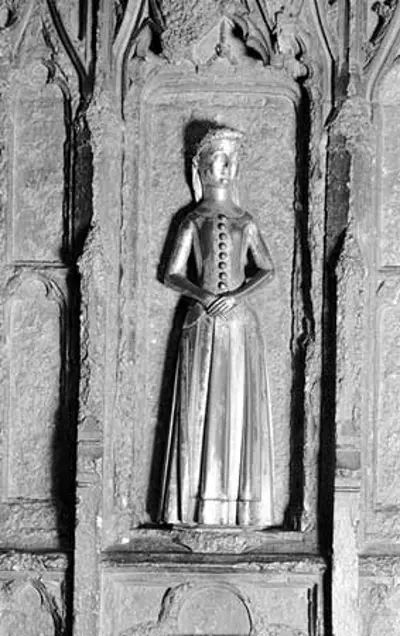
Mary of Waltham, Duchess of Brittany, was a daughter of King Edward III of England and Philippa of Hainault and was the wife of John IV of Brittany, known in England as "John V" an…
Mary of Waltham, duchess of Brittany (died 1361)
Constantine II, , born Guy de Lusignan, was elected the first Latin King of Armenian Cilicia of the Poitiers-Lusignan dynasty, ruling from 1342 until his death in 1344.
Constantine II, King of Armenia
The Latin Church is the largest autonomous particular church within the Catholic Church, whose members constitute the vast majority of the 1.3 billion Catholics. The Latin Church i…
A Latin Christian fleet defeats a Turkish fleet in the battle of Pallene during the Smyrniote crusades
Levi ben Gershon, better known by his Graecized name as Gersonides, or by his Latinized name Magister Leo Hebraeus, or in Hebrew by the abbreviation of first letters as RaLBaG, was…
Gersonides, French Jewish philosopher, Talmudist, mathematician, physician, and astronomer (born 1288)
Joan of Savoy, was Duchess consort of Brittany by marriage to John III, Duke of Brittany. Joan was the claimant to the County of Savoy upon the death of her father in 1329 until 13…
Joan of Savoy, duchess consort of Brittany, throne claimant of Savoy (born 1310)
Ulrich III was Count of Württemberg from 1325 until his death in 1344.
Ulrich III, Count of Württemberg (born c. 1286)
Al-Nasir Shihab ad-Din Ahmad ibn Muhammad ibn Qalawun, better known as al-Nasir Ahmad, was the Turkic Bahri Mamluk sultan of Egypt, ruling from January to June 1342. A son of Sulta…
An-Nasir Ahmad, Sultan of Egypt (born 1316)
Joan of France, also known as Joan or Joanna of Valois, was Queen of Navarre by marriage to Charles II of Navarre. She was the daughter of John II of France, and Bonne of Luxembour…
Joan of Valois, Queen of Navarre (died 1373)
Aymon, Count of Savoy (1291–1343), also known as Aymon the Peaceful, was a nobleman who ruled the County of Savoy from 1329 until his death in 1343. He was a member of the House of…
Aimone, Count of Savoy (born 1291)
Saint George's Night Uprising in 1343–1345 was an unsuccessful attempt by the indigenous Estonian population in the Duchy of Estonia, the Bishopric of Ösel-Wiek, and the insular te…
St
Jeanne de Clisson (1300–1359), also known as Jeanne de Belleville and the Lioness of Brittany, was a French–Breton noblewoman who became a privateer to avenge her husband after he …
After the execution of her husband, Jeanne de Clisson sells her estates and raises a force of men with which to attack…
Giacomo Gaetani Stefaneschi was an Italian cardinal deacon in the Catholic Church.
Giacomo Gaetani Stefaneschi, Italian cardinal (born c
Philip III, called the Noble, the Wise, and of Évreux, was the king of Navarre with his wife Joan II from 1328 until his death in 1343. He was also the count of Évreux in France fr…
Philip III of Navarre (born 1306)
Avignon is the prefecture of the Vaucluse department in the Provence-Alpes-Côte d'Azur region of southern France. Located on the left bank of the river Rhône, the commune has a pop…
In Avignon, France, Cardinal Pierre Roger is elected Pope and takes the name Clement VI
St. Mary Magdalene's flood was the largest recorded flood in central Europe with water levels exceeding those of the 2002 European floods. It occurred on and around the feast day o…
St. Mary Magdalene's flood is the worst such event on record for central Europe.