Henry II of Navarre (born 1503)
Henry II, nicknamed Sangüesino because he was born in Sangüesa, was the King of Navarre from 1517. The kingdom had been reduced to a small territory north of the Pyrenees mountains…
Henry II of Navarre (born 1503)
Explore 133 historical events from 1550β1559.
Henry II, nicknamed Sangüesino because he was born in Sangüesa, was the King of Navarre from 1517. The kingdom had been reduced to a small territory north of the Pyrenees mountains…
Henry II of Navarre (born 1503)
Thomas Drury was an English government informer, messenger and swindler, who is noted for having been one of the main people responsible for accusations of heresy, blasphemy, and …
Thomas Drury, English government informer and swindler (died 1603)
Pietro de' Medici was a Tuscan prince of the House of Medici as a son of Cosimo I de' Medici, Grand Duke of Tuscany, and a knight of the Order of the Golden Fleece.
Pietro de' Medici, Italian noble (died 1604)
Gemma Frisius was a Dutch physician, mathematician, cartographer, philosopher, and instrument maker. He created important globes, improved the mathematical instruments of his day a…
Gemma Frisius, Dutch physician, mathematician, and cartographer (born 1508)
Polydore Vergil or Virgil, widely known as Polydore Vergil of Urbino, was an Italian humanist scholar, historian, priest and diplomat, who spent much of his life in England. He is …
Polydore Vergil, English historian (born 1470)
Elisabeth of Brandenburg was a Duchess consort of Brunswick-Göttingen-Calenberg by marriage to Eric I, Duke of Brunswick-Lüneburg, and Regent of the Duchy of Brunswick-Göttingen-Ca…
Elisabeth of Brandenburg, Duchess of Brunswick-Calenberg-Göttingen (born 1510)
William Camden was an English antiquarian, historian, topographer, and herald, best known as author of Britannia, the first chorographical survey of the islands of Great Britain an…
William Camden, English historian and topographer (died 1623)
Louise of Lorraine was Queen of France as the wife of King Henry III from their marriage on 15 February 1575 until his death on 2 August 1589. During the first three months of thei…
Louise of Lorraine, Queen of France (died 1601)
Tabin-shwë-hti, also called Black Tongue (လျှာနက်မင်း), was King of Burma from 1530 to 1550, and the founder of the First Toungoo Empire. His military campaigns (1534–1549) created…
Tabinshwehti, Burmese king (born 1516)
Mary, Queen of Scots, also known as Mary Stuart or Mary I of Scotland, was Queen of Scotland from 14 December 1542 until her forced abdication on 24 July 1567.
Mary, Queen of Scots, marries the Dauphin of France, François, at Notre-Dame de Paris
John Knox was a Scottish minister, Reformed theologian, and writer who was a leader of the country's Reformation. He was the reformer of the Church of Scotland.
John Knox returns from exile to Scotland to become the leader of the nascent Scottish Reformation
Tristán de Luna y Arellano was a Spanish explorer and conquistador of the 16th century.
Don Tristan de Luna y Arellano sails for Florida with party of 1,500, intending to settle on gulf coast (Vera Cruz, Mexi
Tristán de Luna y Arellano was a Spanish explorer and conquistador of the 16th century.
Don Tristan de Luna y Arellano sails for Florida with a party of 1,500, intending to settle on the gulf coast (Vera Cruz
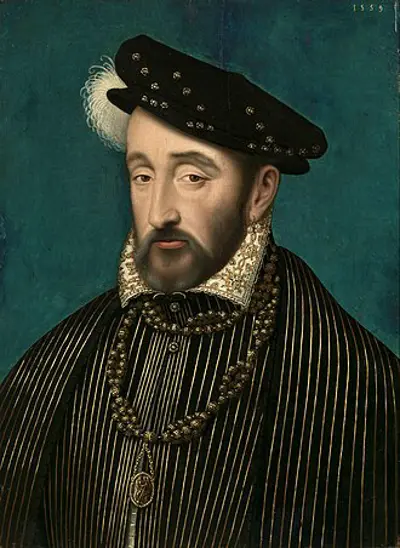
Henry II was King of France from 1547 until his death in 1559. The second son of Francis I and Claude, Duchess of Brittany, he became Dauphin of France upon the death of his elder …
King Henry II of France is mortally wounded in a jousting match against Gabriel, comte de Montgomery
In Christianity, an archbishop is a bishop of higher rank or office. In most cases, such as the Catholic Church, there are many archbishops who either have jurisdiction over an ecc…
Spanish archbishop Bartolomé Carranza is arrested for heresy.
Alice Spencer, Countess of Derby was an English noblewoman from the Spencer family and noted patron of the arts. Poet Edmund Spenser represented her as "Amaryllis" in his eclogue C…
Alice Spencer, English noblewoman (died 1637)
Lawrence of Brindisi, OFM Cap., born Giulio Cesare Russo, was an Italian Catholic priest, theologian and member of the Order of Friars Minor Capuchin. An accomplished linguist, in …
Lawrence of Brindisi, Italian priest and saint (died 1619)
Henry II was King of France from 1547 until his death in 1559. The second son of Francis I and Claude, Duchess of Brittany, he became Dauphin of France upon the death of his elder …
Henry II, king of France (born 1519)
Pope Paul IV, born Gian Pietro Carafa, was head of the Catholic Church and leader of the Papal States from 23 May 1555 to his death, in August 1559. While serving as papal nuncio i…
Pope Paul IV (born 1476)
Isabella Jagiellon was a princess of the Kingdom of Poland and of the Grand Duchy of Lithuania, and later also the Queen consort of Hungary. She was the oldest child of Sigismund I…
Isabella Jagiellon, Queen of Hungary (born 1519)
Presbyterianism is a historically Reformed Protestant tradition named after its form of church government by representative assemblies of elders, known as "presbyters". Though othe…
Presbyterian clergyman John Knox returned from exile to lead the Scottish Reformation
Jousting is a medieval and renaissance martial game or hastilude between two combatants either on horse or on foot. The joust became an iconic characteristic of the knight in Roman…
During a jousting match, King Henry II of France was mortally wounded when fragments of Gabriel Montgomery's lance pierc
Robert I Estienne, known as Robertus Stephanus in Latin and sometimes referred to as Robert Stephens, was a French 16th-century printer in Paris. He was the proprietor of the Estie…
Robert Estienne, English-French printer and scholar (born 1503)
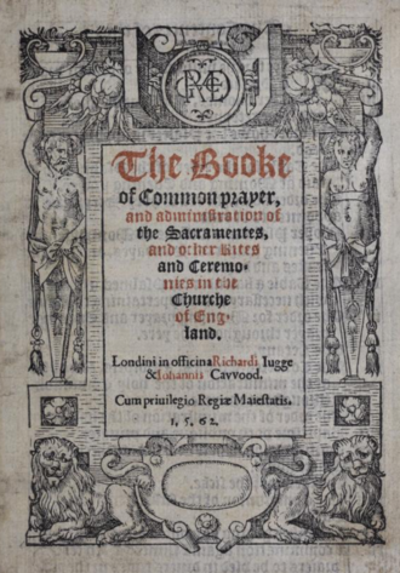
The 1559 Book of Common Prayer, also called the Elizabethan prayer book, is the third edition of the Book of Common Prayer and the text that served as an official liturgical book o…
The 1559 Book of Common Prayer, a major component of the Elizabethan Religious Settlement, is legally introduced as the
The 1559 Book of Common Prayer, also called the Elizabethan prayer book, is the third edition of the Book of Common Prayer and the text that served as an official liturgical book o…
The Book of Common Prayer, a major component of the Elizabethan religious settlement, was introduced as the liturgy of…
Mary, Queen of Scots, also known as Mary Stuart or Mary I of Scotland, was Queen of Scotland from 14 December 1542 until her forced abdication on 24 July 1567.
Mary, Queen of Scots, marries the Dauphin of France, François, at Notre-Dame de Paris
The Battle of Gravelines was fought on 13 July 1558 at Gravelines, near Calais, France. It occurred during the twelve-year war between France and Spain (1547–1559).
Battle of Gravelines: In France, Spanish forces led by Count Lamoral of Egmont defeat the French forces of Marshal…
Robert Greene (1558–1592) was a popular Elizabethan dramatist and pamphleteer. He is said to have been born in Norwich. He attended Cambridge where he received a BA in 1580, and an…
Robert Greene, English author and playwright (died 1592)
George Clifford, 3rd Earl of Cumberland, 13th Baron de Clifford, 13th Lord of Skipton, was an English peer, naval commander, and courtier of Queen Elizabeth I of England. He was no…
George Clifford, 3rd Earl of Cumberland, English noble (died 1605)
Philippe-Emmanuel de Lorraine, Duke of Mercœur and of Penthièvre was a French soldier, a prince of the Holy Roman Empire and a prominent member of the Catholic League, who fought f…
Philippe Emmanuel, Duke of Mercœur (died 1602)
Johannes Bugenhagen, also called Doctor Pomeranus by Martin Luther, was a German theologian and Lutheran priest who introduced the Protestant Reformation in the Duchy of Pomerania …
Johannes Bugenhagen, German priest and theologian (born 1485)
Jean François Fernel was a French physician who introduced the term "physiology" to describe the study of the body's function. He was the first person to describe the spinal canal.…
Jean Fernel, French physician (born 1497)
Francisco de Sá de Miranda was a Portuguese poet of the Renaissance.
Francisco de Sá de Miranda, Portuguese poet (born 1485)
Elisabeth of Brandenburg was a Duchess consort of Brunswick-Göttingen-Calenberg by marriage to Eric I, Duke of Brunswick-Lüneburg, and Regent of the Duchy of Brunswick-Göttingen-Ca…
Elisabeth of Brandenburg, Duchess of Brunswick-Calenberg-Göttingen (born 1510)