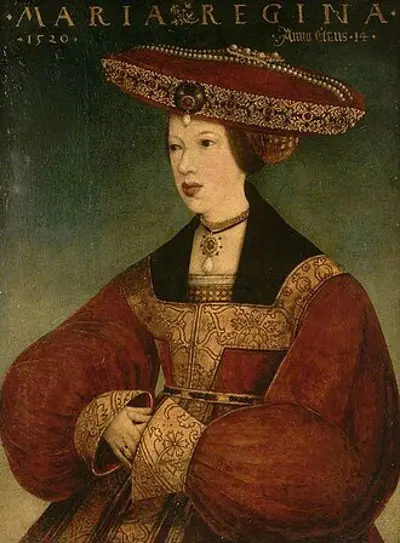
Anne of Cleves, Queen consort of England (born 1515)
Anne of Cleves was Queen of England as the fourth wife of Henry VIII from 6 January to 12 July 1540.
Anne of Cleves, Queen consort of England (born 1515)
Explore 93 historical events from 1550β1559.
Anne of Cleves was Queen of England as the fourth wife of Henry VIII from 6 January to 12 July 1540.
Anne of Cleves, Queen consort of England (born 1515)
Petrus Apianus, also known as Peter Apian, Peter Bennewitz, and Peter Bienewitz, was a German humanist, known for his works in mathematics, astronomy and cartography. His work on "…
Petrus Apianus, German mathematician and astronomer (born 1495)
The Stratford Martyrs were eleven men and two women who were burned at the stake together for their Protestant beliefs, either at Stratford-le-Bow, Middlesex or Stratford, Essex, b…
The thirteen Stratford Martyrs are burned at the stake near London for their Protestant beliefs
Prince Jerzy Radziwiłł was a Polish–Lithuanian magnate and Imperial Reichsfürst from the Radziwiłł family. He was ordained a Catholic priest and later rose through the ranks as Bis…
Jerzy Radziwiłł, Catholic cardinal (died 1600)
François Béroalde de Verville was a French Renaissance novelist, poet and intellectual. He was born in Paris, the son of Matthieu Brouard, called "Béroalde", a professor of Agrippa…
François Béroalde de Verville, French writer (died 1626)
George Peele was an English translator, poet, and dramatist, who is most noted for his supposed, but not universally accepted, collaboration with William Shakespeare on the play T…
George Peele, English translator, poet, and dramatist (died 1596)
Luigi Alamanni was an Italian poet and statesman. He was regarded as a prolific and versatile poet. He was credited with introducing the epigram into Italian poetry.
Luigi Alamanni, Italian poet and politician (born 1495)
Saitō Dōsan , also known as Saitō Toshimasa, was a Japanese samurai lord and daimyo during the Sengoku period. He was also known as the "Viper of Mino" for his ruthless tactics. H…
Saitō Dōsan, Japanese samurai (born 1494)
Martin Agricola was a German composer of Renaissance music and a music theorist.
Martin Agricola, German composer and theorist (born 1486)
Ludovico Carracci was an Italian early-Baroque painter, etcher, and printmaker from Bologna. His works are characterized by a strong mood invoked by broad gestures and flickering l…
Ludovico Carracci, Italian painter and etcher (died 1619)
Jerónima de la Asunción, O.S.C. was a Spanish Catholic nun and abbess who founded the Real Monasterio de Santa Clara in Intramuros, Manila, Philippines.
Jerónima de la Asunción, Spanish Catholic nun and founder of the first monastery in Manila (died 1630)
George Carew, 1st Earl of Totnes, known as Sir George Carew between 1586 and 1605 and as The Lord Carew between 1605 and 1626, served under Elizabeth I during the Tudor conquest of…
George Carew, 1st Earl of Totnes, English general and administrator (died 1629)
Lodovico Zacconi was an Italian composer and musical theorist of the late Renaissance and early Baroque eras. He worked as a singer, theologian, and writer on music in northern Ita…
Lodovico Zacconi, Italian composer and theorist (died 1627)
The Ottoman Empire, historically also known as the Turkish Empire, was a state that spanned much of Southeast Europe, West Asia, and North Africa from the 14th century to the early…
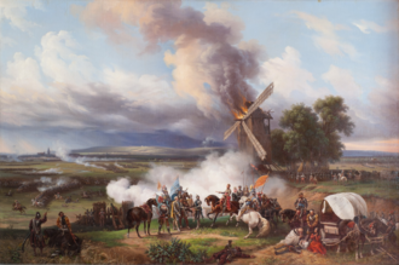
The Ottoman Empire and the Safavid Empire sign a peace treaty to end the Ottoman–Safavid War of 1532–1555
The army of the Mughal Empire was the military force by which the Mughal emperors established and expanded their empire. Although its origins, like the Mughals themselves, were in …
A Mughal army under Humayun and Bairam Khan defeats an Afghan army under Sikandar Shah Suri in the battle of Sirhind, al
The College of Arms is the heraldic authority for England, Wales, Northern Ireland, and some Commonwealth realms; the heraldic authority for Scotland is the Court of the Lord Lyon.…
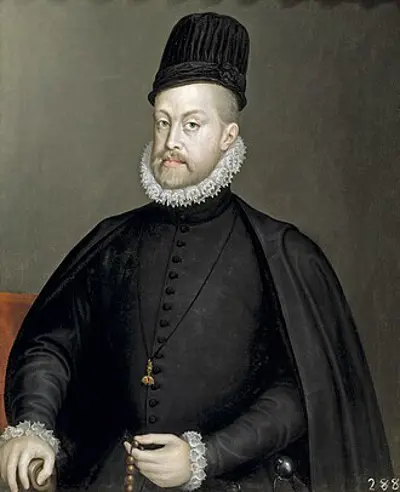
The College of Arms is reincorporated by Royal charter signed by Queen Mary I of England and King Philip II of Spain.
Giovanni Antonio Magini was an Italian astronomer, astrologer, cartographer, and mathematician.
Giovanni Antonio Magini, Italian mathematician, cartographer and astronomer (died 1617)
Polydore Vergil or Virgil, widely known as Polydore Vergil of Urbino, was an Italian humanist scholar, historian, priest and diplomat, who spent much of his life in England. He is …
Polydore Vergil, English historian (born 1470)
Pope Marcellus II, born Marcello Cervini degli Spannocchi, was head of the Catholic Church and ruler of the Papal States from 10 April 1555 to his death, 22 days later.
Pope Marcellus II (born 1501)
Gemma Frisius was a Dutch physician, mathematician, cartographer, philosopher, and instrument maker. He created important globes, improved the mathematical instruments of his day a…
Gemma Frisius, Dutch physician, mathematician, and cartographer (born 1508)
Henry II, nicknamed Sangüesino because he was born in Sangüesa, was the King of Navarre from 1517. The kingdom had been reduced to a small territory north of the Pyrenees mountains…
Henry II of Navarre (born 1503)
John Bradford (1510–1555) was an English Reformer, prebendary of St. Paul's, and martyr. He was imprisoned in the Tower of London for alleged crimes against Queen Mary I. He was bu…
John Bradford, English reformer, prebendary of St. Paul's (born 1510)
Pope Paul IV, born Gian Pietro Carafa, was head of the Catholic Church and leader of the Papal States from 23 May 1555 to his death, in August 1559. While serving as papal nuncio i…
Gian Pietro Carafa became Pope Paul IV, beginning a tumultuous four-year papacy during which the Papal States suffered a
Mary I was Queen of England and Ireland from July 1553 and Queen of Spain as the wife of King Philip II from January 1556 until her death in 1558. She made vigorous attempts to rev…
Queen Mary I grants a royal charter to Derby School, as a grammar school for boys in Derby, England