Elizabeth Carey, Lady Berkeley, English courtier (died 1635)
Lady Elizabeth Berkeley, was an English courtier and patron of the arts.
Elizabeth Carey, Lady Berkeley, English courtier (died 1635)
Explore 175 historical events from 1570β1579.
Lady Elizabeth Berkeley, was an English courtier and patron of the arts.
Elizabeth Carey, Lady Berkeley, English courtier (died 1635)
Caspar Schoppe was a German Catholic polemicist, philosopher and scholar.
Caspar Schoppe, German author and scholar (died 1649)
Giovanni Diodati or Deodati was a Genevan-born Italian Calvinist theologian and translator. His translation of the Bible into Italian from Hebrew, Greek, Latin, and Syriac sources …
Giovanni Diodati, Swiss-Italian minister, theologian, and academic (died 1649)
The Mughal Empire was an early modern empire in South Asia. At its peak, the empire stretched from the outer fringes of the Indus River Basin in the west, northern Afghanistan in t…
Mughal Empire annexes Bengal after defeating the Bengal Sultanate at the Battle of Rajmahal.
Roger Manners, 5th Earl of Rutland was the eldest surviving son of John Manners, 4th Earl of Rutland and his wife, Elizabeth née Charleton. He travelled across Europe, took part in…
Roger Manners, 5th Earl of Rutland (died 1612)
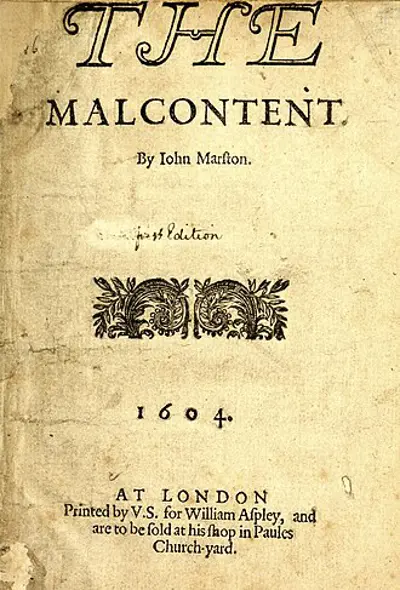
John Marston was an English playwright, poet and satirist during the late Elizabethan and early Jacobean periods. His career as a writer lasted only a decade. His work is remembere…
John Marston, English poet and playwright (died 1634)
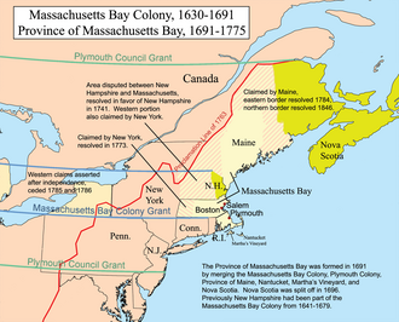
Thomas Dudley was a New England colonial magistrate who served several terms as governor of the Massachusetts Bay Colony. Dudley was the chief founder of Newtowne, later Cambridge,…
Thomas Dudley, English-American soldier and politician, 3rd Governor of the Massachusetts Bay Colony (died 1653)
Tahmasp I was the second shah of Safavid Iran from 1524 until his death in 1576. He was the eldest son of Shah Ismail I and his principal consort, the Mawsillu princess Tajlu Khanu…
Tahmasp I, Shah of Persia (born 1514)
Eleonora di Garzia di Toledo or Leonor Álvarez de Toledo Osorio, more often known as "Leonora" or "Dianora", was the daughter of García Álvarez de Toledo, 4th Marquis of Villafranc…
Eleonora di Garzia di Toledo, Italian noble (born 1553)
Princess Isabella Romola de' Medici, Duchess of Bracciano, was a Tuscan noblewoman, daughter of Cosimo I de' Medici, first Grand Duke of Tuscany, and Eleanor of Toledo. Beautiful, …
Isabella de' Medici, Italian noble (born 1542)
Tiziano Vecellio, Latinized as Titianus, hence known in English as Titian, was an Italian Renaissance painter. The most important artist of Renaissance Venetian painting, he was bo…
Titian, Italian painter and educator (born 1488)
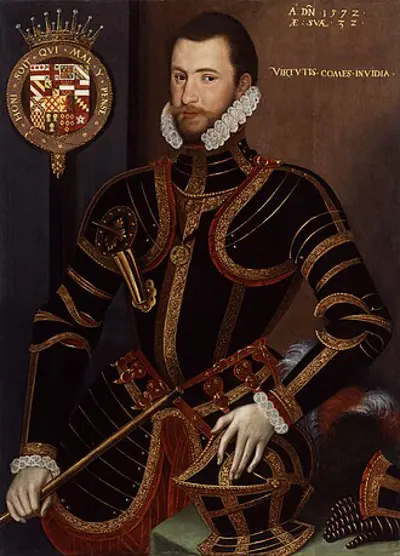
Walter Devereux, 1st Earl of Essex, was an English nobleman and general. From 1573 until his death he fought in Ireland in connection with the Plantations of Ireland, most notably …
Walter Devereux, 1st Earl of Essex (born 1541)
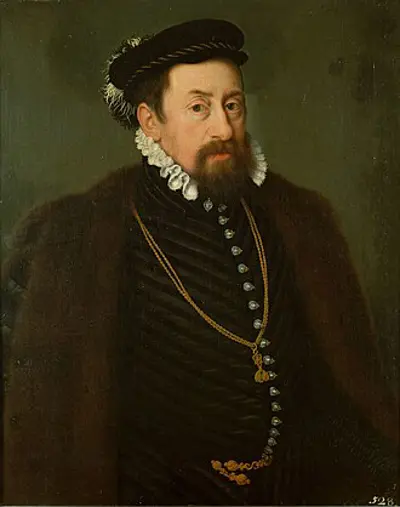
Maximilian II was Holy Roman Emperor from 1564 until his death in 1576. A member of the Austrian House of Habsburg, he was crowned King of Bohemia in Prague on 14 May 1562 and elec…
Maximilian II, Holy Roman Emperor (born 1527)
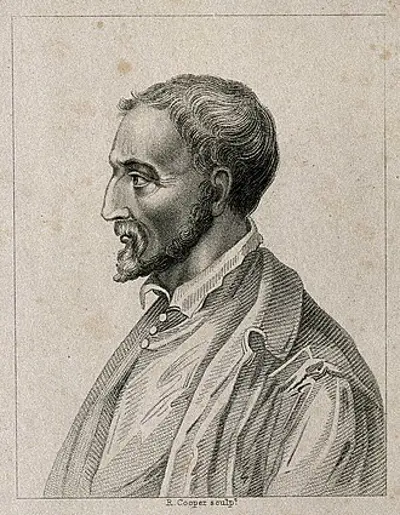
Gerolamo Cardano was an Italian polymath whose interests and proficiencies ranged through those of mathematician, physician, biologist, physicist, chemist, astrologer, astronomer, …
Gerolamo Cardano, Italian mathematician, physician, and astrologer (born 1501)
Stephen Báthory was King of Poland and Grand Duke of Lithuania as well as Prince of Transylvania (1576–1586), after previously being Voivode of Transylvania (1571–1576).
Stephen Báthory and Anna Jagiellon (pictured) were crowned as the elected rulers of the Polish–Lithuanian Commonwealth
A cornerstone is the first stone set in the construction of a masonry foundation. All other stones will be set in reference to this stone, thus determining the position of the enti…
The cornerstone of Danish astronomer Tycho Brahe's observatory Uraniborg was laid on the island of Hven.
The Sengoku period was the period in Japanese history in which civil wars and social upheavals took place almost continuously in the 15th and 16th centuries. The Kyōtoku incident …
Sengoku period of Japan: The combined forces of Oda Nobunaga and Tokugawa Ieyasu are victorious in the Battle of Nagashi
The Raid of the Redeswire, also known as the Redeswire Fray, was a border skirmish between England and Scotland on 7 July 1575 which took place at Carter Bar, the Cheviot pass whic…
The Raid of the Redeswire is the last major battle between England and Scotland.
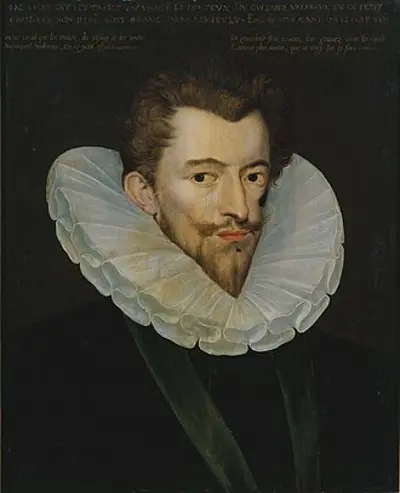
Henri I de Lorraine, Duke of Guise, Prince of Joinville, Count of Eu, sometimes called Le Balafré ('Scarface'), was the eldest son of François, Duke of Guise, and Anna d'Este. His …
Roman Catholic forces under Henry I, Duke of Guise, defeat the Protestants, capturing Philippe de Mornay among others.
Marie de' Medici was Queen of France and Navarre as the second wife of King Henry IV. Marie served as regent of France between 1610 and 1617 during the minority of her son Louis XI…
Marie de' Medici, queen of Henry IV of France (died 1642)
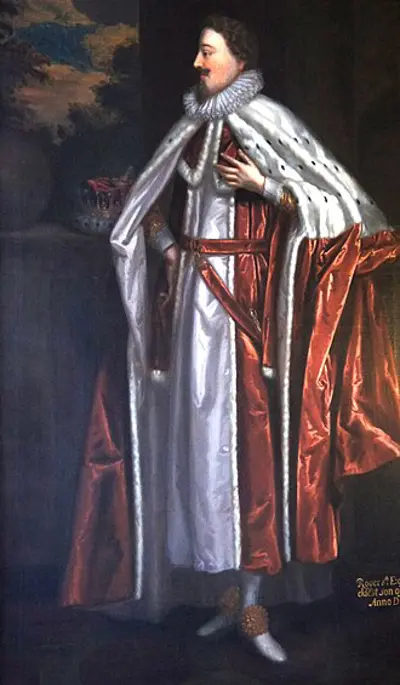
Sir Robert Heath was an English judge and politician who sat in the House of Commons from 1621 to 1625.
Robert Heath, English judge and politician (died 1649)
Anne Catherine of Brandenburg was Queen of Denmark and Norway from 1597 to 1612 as the first spouse of King Christian IV of Denmark.
Anne Catherine of Brandenburg (died 1612)
Bartol Kašić was a Croatian Jesuit clergyman and grammarian during the Counter-Reformation, who wrote the first Illyrian grammar and translated the Bible and the Roman Rite into Il…
Bartol Kašić, Croatian linguist and lexicographer (died 1650)
Matthew Parker was an English bishop. He was the Archbishop of Canterbury in the Church of England from 1559 to his death. He was also an influential theologian and arguably the co…
Matthew Parker, English archbishop and academic (born 1504)