Victor Amadeus I, Duke of Savoy (died 1637)
Victor Amadeus I was the Duke of Savoy and ruler of the Savoyard states from 26 July 1630 until his death in 1637. He was also known as the Lion of Susa.
Victor Amadeus I, Duke of Savoy (died 1637)
Explore 31 historical events from 1580β1589.
Victor Amadeus I was the Duke of Savoy and ruler of the Savoyard states from 26 July 1630 until his death in 1637. He was also known as the Lion of Susa.
Victor Amadeus I, Duke of Savoy (died 1637)
Conquistadors or conquistadores were Spanish and Portuguese colonizers who explored, traded with, and colonized many parts of the Americas, Africa, Asia, and Oceania during the Age…
Spanish conquistador Hernando de Lerma founds the settlement of Salta, Argentina
Thomas Middleton was an English Jacobean playwright and poet. He, with John Fletcher and Ben Jonson, was among the most successful and prolific of playwrights at work in the Jacobe…
Thomas Middleton, English Jacobean playwright and poet (died 1627)
Rose of Lima, TOSD, was a member of the Third Order of Saint Dominic in Lima, Peru, Spanish Empire, who became known for both her life of severe penance and her care of the poverty…
Rose of Lima, Peruvian mystic and saint (died 1617)
John Ford was an English playwright and poet of the Jacobean and Caroline eras born in Ilsington in Devon, England. His plays deal mainly with the conflict between passion and cons…
John Ford, English poet and playwright (died 1639)
Sophie of Saxony was a member of the Albertine branch of the House of Wettin. She was a princess of Saxony by birth and by marriage a Duchess of Pomerania-Stettin.
Sophie of Saxony, Duchess of Pomerania (died 1635)
Anne Seymour, Duchess of Somerset was the second wife of Edward Seymour, 1st Duke of Somerset, who held the office of Lord Protector during the first part of the reign of their nep…
Anne Seymour, Duchess of Somerset (born 1497)
John Foxe was an English clergyman, theologian, and historian, notable for his martyrology Foxe's Book of Martyrs, telling of Christian martyrs throughout Western history, but part…
John Foxe, English historian and author (born 1516)
Sir Henry Sidney was an English soldier, politician and Lord Deputy of Ireland. Instrumental in the Tudor conquest of Ireland, his attempts to consolidate English power in Ireland …
Henry Sidney, Irish politician, Lord Deputy of Ireland (born 1529)
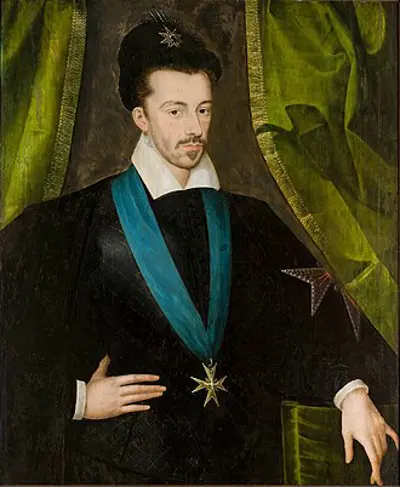
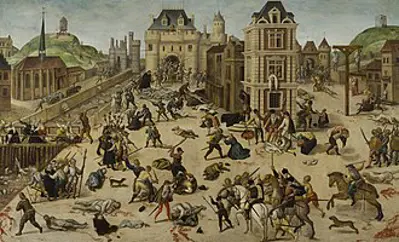
The French Wars of Religion were a series of civil wars between French Catholics and Protestants from 1562 to 1598. Between two and four million people died from violence, famine o…
French Wars of Religion: Henry III of France flees Paris after Henry I, Duke of Guise, enters the city and a spontaneous
Robert Arnauld d’Andilly was a French conseiller d’État, specialising in financial questions, in the court of Marie de' Medici. By the elegance of his language, he was among the ma…
Robert Arnauld d'Andilly, French writer (died 1674)
Julius of Brunswick-Lüneburg, a member of the House of Welf, was Duke of Brunswick-Lüneburg and ruling Prince of Brunswick-Wolfenbüttel from 1568 until his death. From 1584, he als…
Julius, Duke of Brunswick-Lüneburg (born 1528)
The French Wars of Religion were a series of civil wars between French Catholics and Protestants from 1562 to 1598. Between two and four million people died from violence, famine o…
French Wars of Religion: Henry III of France flees Paris after Henry I, Duke of Guise, enters the city and a spontaneous
Ole Worm, who often went by the Latinized form of his name Olaus Wormius, was a Danish physician, natural historian and antiquary. He was a professor at the University of Copenhage…
Ole Worm, Danish physician and historian (died 1654)
Pierre Séguier was a French statesman who was the chancellor of France from 1635.
Pierre Séguier, French politician, Lord Chancellor of France (died 1672)
Paolo Caliari, known as Paolo Veronese, was an Italian Renaissance painter based in Venice, known for extremely large history paintings of religion and mythology, such as The Weddi…
Paolo Veronese, Italian painter (born 1528)
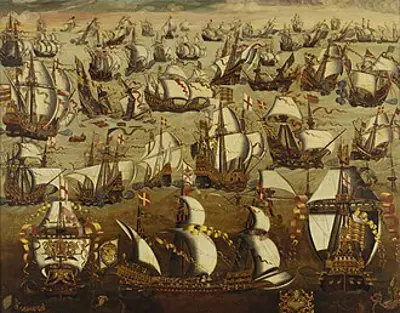
The Spanish Armada was a Spanish fleet that sailed from Lisbon in late May 1588, and was the largest engagement of the undeclared Anglo-Spanish War. The Armada was commanded by Alo…
The Spanish Armada, with 130 ships and 30,000 men, sets sail from Lisbon, Portugal, heading for the English Channel
The Spanish Armada was a Spanish fleet that sailed from Lisbon in late May 1588, and was the largest engagement of the undeclared Anglo-Spanish War. The Armada was commanded by Alo…
The last ship of the Spanish Armada sets sail from Lisbon heading for the English Channel
Sophie of Saxony was a member of the Albertine branch of the House of Wettin. She was a princess of Saxony by birth and by marriage a Duchess of Pomerania-Stettin.
Sophie of Saxony, Duchess of Pomerania (died 1635)
Victor Amadeus I was the Duke of Savoy and ruler of the Savoyard states from 26 July 1630 until his death in 1637. He was also known as the Lion of Susa.
Victor Amadeus I, Duke of Savoy (died 1637)
Anne Seymour, Duchess of Somerset was the second wife of Edward Seymour, 1st Duke of Somerset, who held the office of Lord Protector during the first part of the reign of their nep…
Anne Seymour, Duchess of Somerset (born 1497)
John Foxe was an English clergyman, theologian, and historian, notable for his martyrology Foxe's Book of Martyrs, telling of Christian martyrs throughout Western history, but part…
John Foxe, English historian and author (born 1516)
John Ford was an English playwright and poet of the Jacobean and Caroline eras born in Ilsington in Devon, England. His plays deal mainly with the conflict between passion and cons…
John Ford, English poet and playwright (died 1639)
Rose of Lima, TOSD, was a member of the Third Order of Saint Dominic in Lima, Peru, Spanish Empire, who became known for both her life of severe penance and her care of the poverty…
Rose of Lima, Peruvian mystic and saint (died 1617)
Paul Siefert was a German composer and organist associated with the North German school.
Paul Siefert, German composer and organist (died 1666)
Sir Henry Sidney was an English soldier, politician and Lord Deputy of Ireland. Instrumental in the Tudor conquest of Ireland, his attempts to consolidate English power in Ireland …
Henry Sidney, Irish politician, Lord Deputy of Ireland (born 1529)
Zofia Radziwiłł, also Zofia of Słuck is a Polish-Lithuanian Orthodox Christian saint. She was the last descendant of the Olelkowicz–Słucki family – princes of Slutsk and Kopyl – wh…
Sophia Olelkovich Radziwill, Belarusian saint (died 1612)
Henry of Saxe-Lauenburg was a Prince-Archbishop of Bremen, then Prince-Bishop of Osnabrück, then Prince-Bishop of Paderborn.
Henry of Saxe-Lauenburg, Prince-Archbishop of Bremen, Prince-Bishop of Osnabrück and Paderborn (born 1550)
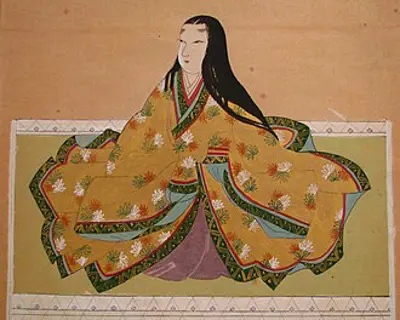
Niwa Nagahide , also known as Gorōzaemon (五郎左衛門), his other legal alias was Hashiba Echizen no Kami (羽柴越前守), was a Japanese samurai of the Sengoku through Azuchi-Momoyama periods o…
Niwa Nagahide, Japanese samurai (born 1535)
Marc Antoine Muret, better known by his Latinized name Marcus Antonius Muretus, was a French humanist who was among the revivers of an Attic, or anti-Ciceronian, prose style, and i…
Muretus, French philosopher and author (born 1526)
Santiago de Vera was a native of Alcalá de Henares, Spain and the sixth Spanish governor of the Philippines, from May 16, 1584, until May 1590.
Santiago de Vera becomes sixth governor-general of the Spanish colony of the Philippines
Michael Altenburg was a German theologian and composer.
Michael Altenburg, German theologian and composer (died 1640)
Conquistadors or conquistadores were Spanish and Portuguese colonizers who explored, traded with, and colonized many parts of the Americas, Africa, Asia, and Oceania during the Age…
Spanish conquistador Hernando de Lerma founds the settlement of Salta, Argentina
Marco da Gagliano was an Italian composer of the early Baroque era. He was important in the early history of opera and the development of the solo and concerted madrigal.
Marco da Gagliano, Italian composer (died 1643)