1746
280 years ago
Thomas Southerne, Irish playwright (born 1660)
Thomas Southerne was an Irish dramatist.
Thomas Southerne, Irish playwright (born 1660)
Explore 236 historical events from 1740–1749.
Thomas Southerne was an Irish dramatist.
Thomas Southerne, Irish playwright (born 1660)
Colin Maclaurin was a Scottish mathematician who made important contributions to geometry and algebra. He is also known for being a child prodigy and holding the record for being t…
Colin Maclaurin, Scottish mathematician (born 1698)
Thomas Baker was an English antiquarian.
Thomas Baker, English antiquarian and author (born 1656)

Philip V was king of Spain from 1 November 1700 to 14 January 1724 and again from 6 September 1724 to his death in 1746. His total reign is the longest in the history of the Spanis…
Philip V of Spain (born 1683)
Francis Hutcheson was an Irish philosopher widely regarded as one of the key figures of the early Scottish Enlightenment. He served as Professor of Moral Philosophy at the Universi…
Francis Hutcheson, Irish philosopher (born 1694)
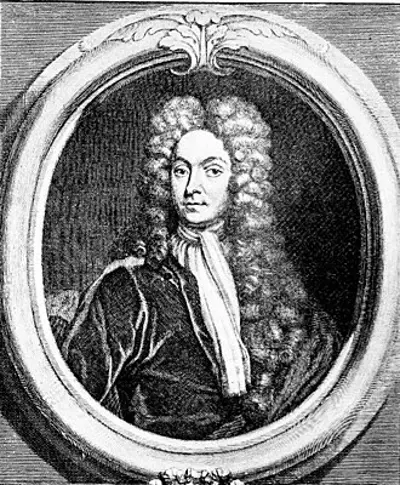
Josiah Burchett, of Hampstead, Middlesex, was a British naval administrator and Whig politician, who sat in the English and British House of Commons between 1705 and 1741. He was S…
Josiah Burchett, English admiral and politician (born 1666)
The Battle of Melle was an encounter battle fought on 9 July 1745, during the War of the Austrian Succession, between forces of the Pragmatic Allies and the French. After their def…
French victory in the Battle of Melle allows them to capture Ghent in the days after.
The history of women's cricket can be traced back to a report in The Reading Mercury on 15 Aug 1745 and a match that took place between the villages of Bramley and Hambledon near G…
The first recorded women's cricket match takes place near Guildford, England.

The Battle of Hohenfriedberg or Hohenfriedeberg, also known as the Battle of Striegau was one of Frederick the Great's most admired victories. Frederick's Prussian army decisively …
Battle of Hohenfriedberg: Frederick the Great's Prussian army decisively defeat an Austrian army under Prince Charles Al
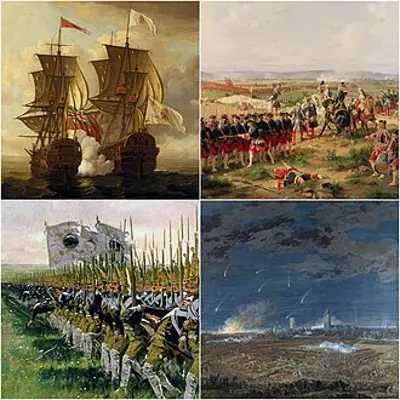
The War of the Austrian Succession, 1740 to 1748, was a conflict between the European great powers, fought primarily in Europe, the Atlantic Ocean and Mediterranean Sea. Related co…
War of the Austrian Succession: New England colonial troops under the command of William Pepperrell capture the Fortress

New England is a region consisting of six states in the Northeastern United States: Connecticut, Maine, Massachusetts, New Hampshire, Rhode Island, and Vermont. It is bordered by t…
A New England colonial army captures the French fortifications at Louisbourg (New Style)
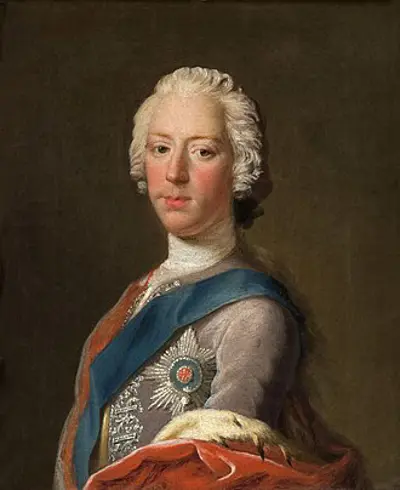
Charles Edward Louis John Sylvester Maria Casimir Stuart was the elder son of James Francis Edward Stuart, making him the grandson of James VII and II, and the Stuart claimant to t…
Prince Charles Edward Stuart raises his standard in Glenfinnan: The start of the Second Jacobite Rebellion, known as…
The Ottoman–Persian War of 1743–1746 or Ottoman–Iranian War of 1743–1746 was fought between the Ottoman Empire and Afsharid Iran.
Ottoman–Persian War: In the Battle of Kars, the Ottoman army is routed by Persian forces led by Nader Shah.
Lieutenant-General Sir John Cope was a British Army officer and Whig politician. He is now chiefly remembered for his defeat at Prestonpans, the first significant battle of the Jac…
A British government army led by Sir John Cope is defeated in less than 15 minutes by the Jacobite forces of Prince…
Philippe Pinel was a French physician, precursor of psychiatry and incidentally a zoologist. He was instrumental in the development of a more humane psychological approach to the c…
Philippe Pinel, French physician and psychiatrist (died 1826)
Oliver Ellsworth was a Founding Father of the United States, attorney, jurist, politician, and diplomat. Ellsworth was a framer of the United States Constitution, United States sen…
Oliver Ellsworth, American lawyer and politician, 3rd Chief Justice of the United States (died 1807)
Carl Philipp Stamitz, was a German composer of partial Czech ancestry of the Classical era. He was the most prominent representative of the second generation of the Mannheim School…
Carl Stamitz, German violinist and composer (died 1801)
Caspar Wessel was a Danish–Norwegian mathematician and cartographer. In 1799, Wessel was the first person to describe the geometrical interpretation of complex numbers as points in…
Caspar Wessel, Norwegian-Danish mathematician and cartographer (died 1818)
Carl Arnold Kortum was a German medical doctor, but best known for his writing and poetry.
Carl Arnold Kortum, German physician and poet (died 1824)
Admiral of the White Sir Robert Calder, 1st Baronet, was a Royal Navy officer who served in the Seven Years' War, the American Revolutionary War, the French Revolutionary Wars and …
Robert Calder, Scottish-English admiral (died 1818)
Shneur Zalman of Liadi, commonly known as the Alter Rebbe or Baal Hatanya, was a rabbi and the founder and first Rebbe of Chabad, a branch of Hasidic Judaism. He wrote many works a…
Shneur Zalman, Russian rabbi, author and founder of Chabad (died 1812)
Prince Mikhail Illarionovich Golenishchev-Kutuzov-Smolensky was a field marshal of the Russian Empire. He served as a military officer and a diplomat under the reign of three Roman…
Mikhail Kutuzov, Russian field marshal (died 1813)
Tomaso Antonio Vitali was an Italian composer and violinist of the mid to late Baroque era. The eldest son of Giovanni Battista Vitali, he is chiefly known for a Chaconne in G mino…
Tomaso Antonio Vitali, Italian violinist and composer (born 1663)
François Marie de Broglie, 1st Duke of Broglie was a French Royal Army officer and diplomat.
François-Marie, 1st duc de Broglie, French general (born 1671)